
Nigerian startup funding fell to $11.3 million in September 2026, down 96.9% from $364.1 million in August, according to Nairametrics Research. The latest Nigerian startup funding figures show how sharply monthly investment totals can change when a few major deals dominate the market.
Nigerian startups raised $40.5 million in September 2025, meaning this year’s September total was 72.1% lower, but the numbers need context. August’s total included Moove’s $250 million Series C round, Jumia’s $50 million raise, and Yellow Card’s $40 million funding round. Those three transactions alone accounted for $340 million, making the comparison with September particularly stark.
The latest figures therefore raise a more useful question than whether startup funding has collapsed: what kinds of Nigerian businesses are still attracting capital, and how much of that money is coming through debt rather than equity investment?
Why Nigerian Startup Funding Fell in September 2026
The biggest reason for the month-on-month decline is the difference in deal sizes. August benefited from several large transactions, while September’s reported deals were considerably smaller. When a startup raises hundreds of millions of dollars, it can dramatically change a country’s monthly funding total. A quieter month can consequently look like a much broader downturn than the deal count alone suggests.
That does not mean the decline should be dismissed. September’s $11.3 million total was also substantially below the $40.5 million recorded in the same month last year.
The figures show that September 2026 disclosed less capital. They do not, on their own, establish whether investors have become less interested in Nigeria, whether startups are struggling to secure funding, or whether some deals have simply not been announced.
Which Nigerian startups raised money in September?
Nomba and Drive45 recorded the largest individual transactions, with each securing $3 million in debt financing. Nomba obtained its facility from CardinalStone Finance to support its cross-border payments infrastructure. The company is expanding its ability to facilitate payments between African markets and Asia, using banking relationships that provide access to international payment channels.
Drive45, a Nigerian mobility and transport company, secured a $3 million debt facility from TLG Capital. The financing supports its transport business, which provides vehicle access and mobility services to companies.
Together, these deals brought Nigerian startup funding to a reported $11.3 million in September 2026. The total reflects Nairametrics Research’s published breakdown of disclosed fundraising and should not be treated as a complete record of every private investment in Nigeria.
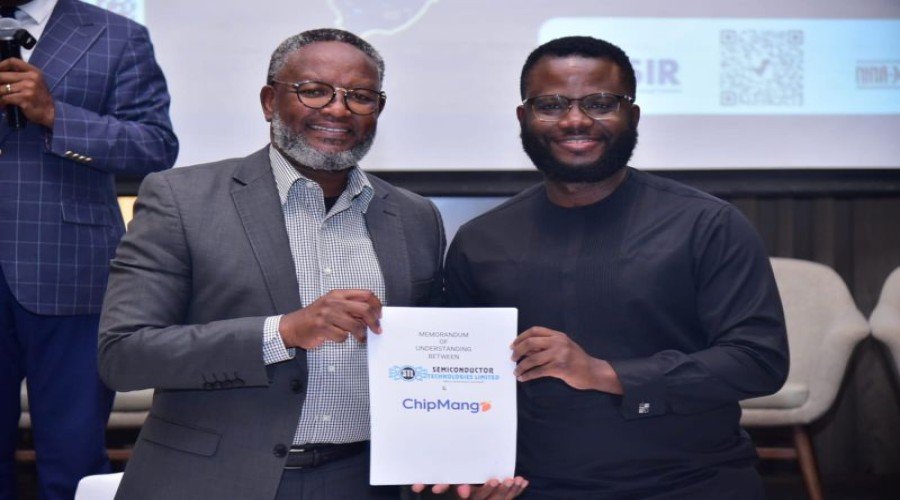
ChipMango recorded a combined $2.1 million across two reported transactions. The semiconductor technology company announced a $1.9 million seed round led by Atlantica Ventures, with participation from DFS Lab, Madica, Kaleo Ventures, Trilinear Technologies, and other investors. A separate $200,000 venture round from Madica brought its combined September total to $2.1 million.
The company develops semiconductor engineering capabilities and works on chip design, verification, and edge-AI technologies. Its fundraising illustrates that capital is reaching businesses operating beyond the more familiar consumer fintech market.
Other reported transactions included
- Aeon: $1 million in pre-seed funding led by Terra Industries.
- Ororo Waste: $1 million in venture funding backed by Rising Tide Africa.
- Noma Services: $700,000 in debt financing.
- Trade Lenda: $200,000 in venture funding.
- AirSmat: $200,000 in venture funding.
- Pewbeam: $100,000 in venture funding.
These transactions, alongside those of Nomba, Drive45, and ChipMango, bring the reported September total to $11.3 million. The figures reflect Nairametrics Research’s published breakdown and should be understood as reported fundraising, rather than a complete record of every private investment in Nigeria.
Nigerian Startup Funding: Debt Accounted for More Than Half
One of the clearest patterns in September’s figures is the amount raised through debt. Nomba, Drive45, and Noma Services secured a combined $6.7 million in debt financing. That represents approximately 59.3% of the month’s $11.3 million total.
Debt and equity funding work differently. Debt provides capital that a company generally must repay under agreed terms. Equity financing involves investors purchasing an ownership stake in a business.
For startups, the distinction matters. Debt can provide money for expansion without requiring founders to issue additional shares, but repayment obligations can put pressure on cash flow. Equity funding can provide capital without scheduled loan repayments, although founders may have to give up part of their ownership.
The September breakdown does not establish why each company chose its particular financing arrangement. It does, however, show why looking only at the total amount raised can leave out an important part of the story.
How does Nigeria compare with the wider African startup market?

Nigeria’s September figures also look modest against the continent’s reported funding activity. According to a separate Nairametrics report, African startups raised $260.3 million across 54 disclosed deals in September 2026. The continent’s ten largest transactions accounted for 85.52% of that total.
Nigerian startup funding represented approximately 4.3% of the $260.3 million raised across Africa in September 2026, based on the reported figures. The comparison also shows how a relatively small number of large transactions can have an outsized influence on monthly funding totals across the region.
It is important, however, not to treat the continental comparison as proof that investors are abandoning Nigeria. The figures capture disclosed transactions during a particular month. They do not measure every fundraising attempt, private investment, or investor decision across the continent.
For a clearer picture of Nigeria’s position, future reports will need to show how funding is distributed across countries, sectors, deal sizes, and financing types over a longer period.
Conclusion
The next monthly funding reports will help establish whether September was an unusually weak month or part of a more sustained slowdown. Three indicators are worth watching: the total amount raised, the number of startups receiving funding, and the balance between debt and equity financing.
The year-on-year comparison is particularly useful. September 2026 saw nine funded startups, up from seven in September 2025, even though the amount raised fell from $40.5 million to $11.3 million. More companies receiving funding does not necessarily mean that access to capital has improved, but it shows why funding totals should not be interpreted in isolation.
For now, Nigerian startup funding remains worth watching after September’s sharp decline in disclosed investment. The absence of August’s mega-deals explains much of the dramatic month-on-month change, while the lower year-on-year total makes the slowdown worth monitoring.
The next question is whether subsequent months bring larger transactions back into the market or whether funding remains concentrated in smaller rounds and debt facilities.
Read more on technology and digital trends on NaysBlog.