
Nigeria agritech funding has reached between $220 million and $270 million in disclosed capital from 2022 through 2025, according to a report published on September 24, 2026.
The money has gone into businesses working across agricultural production, supply chains, farmer financing, food distribution, and other parts of the agriculture value chain. Still, the headline figure does not tell the whole story.
Nigeria’s agritech sector has not experienced a straight line of funding growth. Investment surged in 2022, fell sharply in 2023, and continued to face pressure as investors became more cautious about startups and business models.
What is changing is the type of agricultural businesses attracting capital. Investors are increasingly looking beyond simple digital platforms toward businesses solving harder problems around financing, processing, logistics, supply chains, storage, and market access.
Nigeria Agritech Funding Has Reached Up to $270 Million
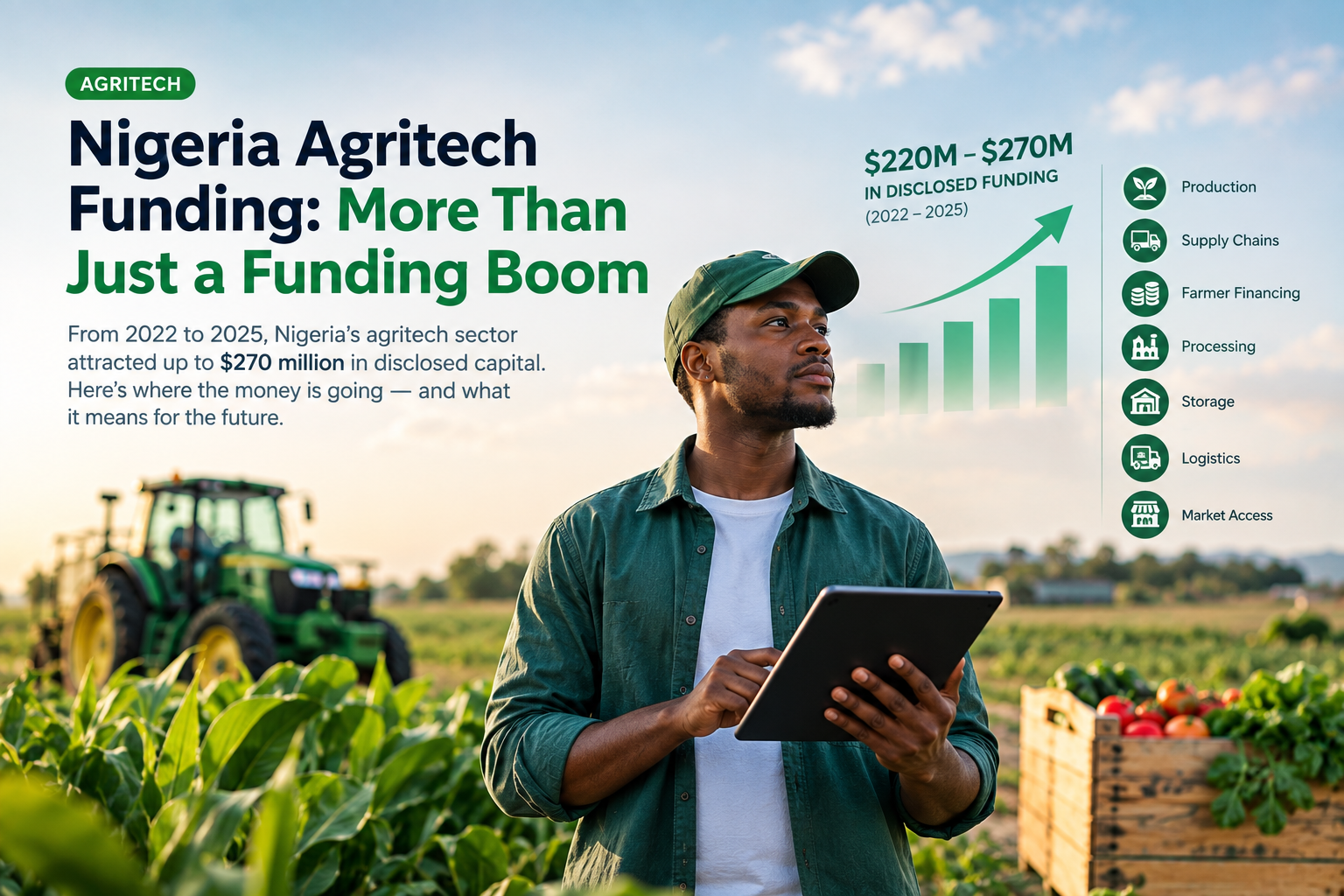
Treat the latest estimate as a measure of disclosed funding, not a single, universally accepted total for Nigeria’s agritech sector.
Different research organizations use different definitions for agritech, agtech, and agrifoodtech. Some focus mainly on technology startups, while broader datasets include businesses operating across the food and agriculture value chain.
Disrupt Africa recorded $72.77 million raised by Nigerian agritech startups in 2022, representing about 55% of the $132.825 million raised by agritech startups across Africa that year. This comes as African startup funding continues to shape Nigeria’s wider technology ecosystem.
A major reason for Nigeria’s strong showing was Thrive Agric. The company raised $56.4 million in debt financing from local commercial banks and institutional investors and also received a $1.75 million co-investment grant from the USAID-funded West Africa Trade & Investment Hub.
That transaction is important because it shows that agritech funding is not limited to the venture-capital rounds usually associated with technology startups.
Agricultural businesses often need working capital, inventory financing, equipment, and other forms of capital to operate and expand.
The Funding Boom Did Not Continue
Nigeria agritech funding surged in 2022 but was followed by a sharp slowdown. Disrupt Africa recorded just $6.75 million across five Nigerian agritech startups in 2023. Across Africa, agritech funding fell from $132.825 million in 2022 to $84.64 million in 2023.
The wider African market remained under pressure in 2024 and 2025. Briter’s latest State of Agtech Investment in Africa report says African agtech funding fell to just under $170 million in 2025, from about $200 million in 2024. It was also the first year in which both total funding and deal count declined in the firm’s tracking history.
That means the Nigerian $220m–$270m figure should not be interpreted as evidence that agritech funding has simply been rising every year.
Instead, it captures a period that included a major funding spike, a subsequent slowdown, and a changing investment environment.
Why Are Investors Still Looking at Nigerian Agritech?
Agriculture remains a large and complicated market in Nigeria. Farmers need access to inputs and finance. Producers need reliable buyers. Processors need a consistent supply of raw materials. Food businesses need storage and transportation. And everyone operating across the value chain has to deal with the cost of moving products from farms to consumers.
Those problems create opportunities for businesses that can use technology to make parts of the agricultural system more efficient, but the opportunity is increasingly about more than putting farmers online.
Agriculture Has Problems Technology Can Help Solve
Technology can help improve how agricultural businesses manage financing, identify buyers, track inventory, coordinate logistics, and process information.
It can also help companies understand where agricultural infrastructure is needed and make supply chains more efficient. Releaf is one example.
The Nigerian agritech company raised $3.3 million in pre-Series A funding in 2023 after a $4.2 million seed round. Its business focuses on improving agricultural supply chains and processing, including technology for sourcing and processing crops.
The model shows why agritech can extend far beyond farm-management apps.
The Opportunity Goes Beyond Farming Apps
Agriculture is a physical industry. A farmer can use an app to receive information, but crops still have to be grown, collected, processed, stored, and transported.
That is increasingly reflected in how investors approach agtech.
Briter’s September 2026 emerging-markets report says investor attention is shifting toward business models with stronger commercial logic, including companies that connect measurable outcomes such as lower costs, higher yields, and better market access directly to their economics.
That makes businesses combining software with physical operations particularly important.
Where the Money Is Going
Nigeria agritech funding is flowing into several parts of the agricultural value chain, from farmer financing and supply chains to processing, storage, and logistics.
Farmer Financing
Access to finance remains one of the major problems for agricultural businesses. Technology can help connect farmers and agribusinesses with lenders, investors, and other financial services.
But the financing model matters.
Briter’s latest African agtech research shows that equity is becoming a smaller share of total sector funding, while debt, hybrid financing, and grants have become more prominent.
For agritech businesses, that could mean more emphasis on financing structures designed around the realities of agriculture rather than relying entirely on traditional venture capital.
Agricultural Supply Chains
Another major opportunity is moving agricultural products more efficiently. Releaf, for example, has built technology around agricultural sourcing and processing. Its platform and equipment are designed to improve how crops move from producers to manufacturers.
This matters because increasing agricultural production is only part of the challenge. Farmers also need access to markets, while processors need reliable supplies.
Technology that connects those parts of the value chain can therefore create value beyond the farm itself.
Processing and Cold Storage
Agricultural infrastructure is another area attracting attention. In June 2026, All On announced a $1 million investment in Eja-Ice Nigeria Limited to strengthen cold-chain infrastructure in off-grid markets. The company provides solar-powered refrigeration and cold-storage solutions.
Cold storage addresses a basic problem: agricultural products can lose value when they cannot be preserved and transported under suitable conditions.
This is where agritech begins to overlap with energy, logistics, and infrastructure.
Logistics and Market Access
The same applies to agricultural logistics. Nigeria’s farmers and agribusinesses need ways to move products from rural production areas to processors, distributors, and urban consumers.
Technology can help businesses coordinate those movements, manage orders, and connect buyers with suppliers, but successful businesses still have to solve the physical logistics problem.
That is one reason the next generation of agritech companies may look less like traditional software startups and more like technology-enabled agricultural infrastructure businesses.
Nigeria Is Trying to Unlock More Agricultural Capital
The startup funding story is also happening alongside broader efforts to bring more private money into Nigerian agriculture. In June 2026, the National Agricultural Development Fund launched a blended-finance initiative designed to attract private-sector investment into agriculture by reducing some of the risks associated with agribusiness investments.
The government-backed initiative is important because Nigeria’s agricultural financing needs extend far beyond startups. Farmers, processors, storage businesses, input suppliers, and other agribusinesses also need capital.
The African Development Bank separately approved a $200 million loan in February 2026 to support agricultural production, value chains, digital and climate-smart agriculture, and other priorities under Nigeria’s National Agricultural Growth Scheme.
Together, these developments show that agricultural finance in Nigeria is not only about venture capital. There is a much wider financing ecosystem developing around the sector.
What This Means for Nigerian Agriculture
For farmers and agribusinesses, the most important question is not simply how much money startups have raised. It is what that capital allows companies to build.
Investment can help expand access to:
- Agricultural finance
- Inputs
- Equipment
- Market information
- Buyers
- Processing facilities
- Storage
- Cold-chain infrastructure
- Logistics
- Digital tools
But funding alone does not guarantee that an agritech business will succeed. Companies still have to acquire customers, generate revenue, control costs, and build business models that can survive after the next funding round.
That is particularly important now that investors are paying closer attention to commercial performance.
The Next Agritech Winners May Look Different
The biggest change in Nigerian agritech may not be another huge funding announcement. It may be the emergence of companies that quietly solve difficult agricultural problems at scale, much like other Nigerian tech startups building businesses around real market problems.
Cold storage, processing, supply chains, agricultural finance, market access, and farm infrastructure. These businesses may not always look like conventional technology startups, but they can use technology to solve problems that affect the wider agricultural economy.
Briter’s latest research reflects this shift across African agtech, with commercial investors returning to the market but using a more selective approach.
For Nigerian founders, that means the question is increasingly not simply whether a business is using technology. It is whether the technology solves a problem customers are willing to pay to fix.
Conclusion
The next phase of Nigeria’s agritech market will be worth watching for several reasons. Investors will likely pay attention to whether startups can demonstrate sustainable revenue, whether agricultural businesses can attract more debt and blended finance, and whether technology companies can expand beyond pilot projects.
The funding mix will also matter. If equity remains harder to secure while debt, grants, and hybrid financing become more important, agritech founders may have to build businesses differently from the venture-backed startups of the previous funding boom.
The sector also has to prove that investment can translate into better agricultural outcomes. That means more efficient supply chains, better access to finance, stronger processing capacity, less post-harvest loss, and improved access to markets.
Nigeria agritech funding has already brought significant capital into the sector. The next question is whether that capital can help build agricultural businesses and infrastructure that are commercially sustainable and useful at scale.
For more stories on technology, startups, business, and digital trends across Nigeria and Africa, visit NaysBlog and keep reading.