
CBN Warns One Cyberattack Could Disrupt Nigeria’s Financial System

CBN cybersecurity is becoming a bigger concern for Nigeria’s financial sector after the Central Bank of Nigeria warned that a cyber incident affecting one bank, fintech, or technology provider could trigger wider disruption across the financial system.
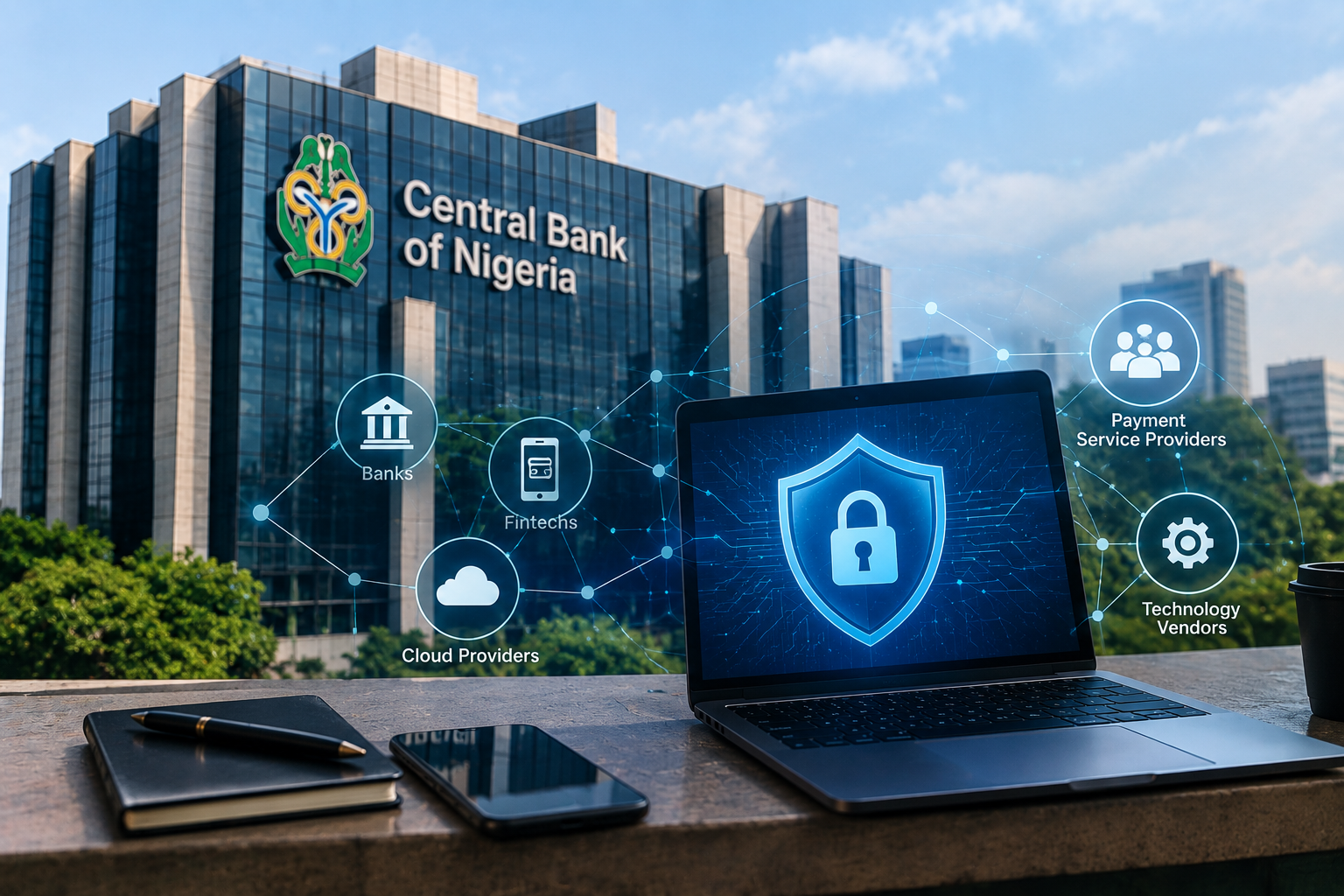
The warning comes as Nigerian financial institutions increasingly depend on fintechs, payment service providers, cloud operators and other technology vendors to deliver digital financial services. According to the CBN, that interconnectedness has created new channels through which a cyber incident or technology failure can spread across the wider financial system.
Dr. Rakiya Opemi Yusuf, Director of the CBN’s Payments System Supervision Department and Chairperson of the Nigeria Electronic Fraud Forum, delivered the warning during the 19th Annual Banking and Finance Conference of the Chartered Institute of Bankers of Nigeria in Abuja.
Her message was straightforward: cybersecurity can no longer be treated as the responsibility of one institution alone.
Why the CBN is worried about interconnected financial systems
Nigeria’s financial system is no longer made up of banks operating independently. Banks now rely on payment service providers, fintech companies, cloud infrastructure, software providers, and other technology companies to support everything from payments to digital banking and customer services, which also creates cybersecurity risks across the wider ecosystem.
That creates convenience, but it also creates dependencies. If a key provider suffers a serious cyberattack or technology failure, connected institutions could also experience disruption.
The CBN’s cybersecurity approach therefore goes beyond an institution’s internal security systems. Financial institutions are expected to examine the risks sitting within their wider technology and service-provider networks.
This is what makes third-party technology risk particularly important.
What is third-party technology risk?
Third-party technology risk is the cybersecurity or operational risk that comes from companies a financial institution depends on but does not directly control. For example, a bank may have strong internal cybersecurity but still depend on an external technology company, payment provider, or cloud service to operate part of its infrastructure.
If that third party is compromised, experiences a major outage, or cannot recover quickly, the bank could still feel the effects. The CBN’s existing cybersecurity framework already requires regulated financial institutions to have processes for assessing and managing risks associated with third-party relationships, including vendor selection, due diligence, monitoring, and incident response.
The latest warning shows that the regulator is increasingly looking at these risks from a financial-system perspective, rather than only asking whether an individual institution is secure.
The CBN wants banks and fintechs to prepare for the wider ecosystem
The CBN is urging financial institutions to regularly examine their technology dependencies and assess whether their external partners can withstand cyberattacks, operational failures, and other disruptions.
But prevention is only part of the issue. The regulator also wants institutions to be able to keep critical services running during an incident and restore normal operations quickly afterwards.
That means resilience matters almost as much as protection. A company may not be able to prevent every cyberattack. But it should be capable of detecting an incident, limiting its impact, communicating the problem, and recovering without allowing the disruption to spread throughout the financial ecosystem.
What the CBN wants banks and fintechs to do
Another part of the CBN’s message is the need for faster reporting when financial institutions discover cyber incidents or vulnerabilities. The reasoning is simple: the earlier regulators and other relevant institutions know about a threat, the more opportunity they have to contain it before it spreads.
The CBN is also calling for stronger information and intelligence sharing between institutions. Instead of every bank or fintech dealing with emerging cyber threats in isolation, financial institutions can share information about attacks, vulnerabilities, and changing tactics used by cybercriminals.
Some of those threats can also reach customers directly through tactics such as phishing and email scams. That could make it easier for the industry to identify patterns and respond before the same weakness affects multiple organizations.
Why the CBN wants stronger Security Operations Centers
The regulator also highlighted the importance of stronger Security Operations Centers (SOCs) capable of monitoring threats in real time. A SOC essentially provides a central capability for detecting, investigating, and responding to suspicious activity across an organization’s digital environment.
For financial institutions handling large volumes of payments and sensitive customer information, the ability to identify unusual activity quickly can be critical.
The bigger objective is not simply to stop every attack. It is to reduce the amount of time a cyber incident can remain undetected and limit how far its effects can travel.
CBN cybersecurity: What the regulator has done in 2026
The latest warning is also part of a broader push by the CBN to strengthen cybersecurity supervision. In March 2026, the regulator deployed its Cybersecurity Self-Assessment Tool (CSAT) for regulated institutions.
The March exercise was another important part of the CBN cybersecurity push, particularly as financial institutions become more dependent on external technology providers.
The tool is designed to give the CBN more information about the cybersecurity posture of financial institutions, including their governance, risk management, technology and third-party controls, incident response capabilities and operational resilience.
That is significant because third-party technology risk is already part of the regulator’s cybersecurity assessment framework. The September warning therefore looks less like an isolated announcement and more like another step in the CBN’s broader effort to make financial institutions more resilient.
What does the warning mean for Nigerian fintech users?
For customers, the CBN’s warning does not mean that Nigerian banks and fintechs are about to suffer a widespread cyberattack. Instead, it highlights a risk that customers may not normally think about: the security of the companies behind the financial services they use.
When a customer sends money through a banking app or fintech platform, several technology systems may be working behind the scenes. That means protecting customer accounts is not only about securing the app itself. The wider infrastructure and third-party companies supporting that service also matter.
For users, the practical expectation should be that financial institutions continue strengthening security, monitoring, incident response, and service recovery.
AI is adding another layer to the cybersecurity challenge.
The CBN’s warning also comes as financial institutions increasingly adopt artificial intelligence. AI can help banks and fintechs automate processes, detect suspicious activity, and improve financial services.
But it also introduces new risks that institutions have to manage.
At the CIBN conference, Yusuf warned that greater automation should not mean losing human responsibility for decisions and their consequences. The principle she highlighted was “automating accountability,” meaning institutions can use AI extensively while still retaining human responsibility.
The CBN also raised concerns around data governance and digital sovereignty, including questions about where critical data is stored, who can access it, and how it is used.
Why one cyberattack could affect more than one institution
The CBN’s latest warning points to a broader problem facing Nigeria’s financial sector. As banks, fintechs, and payment companies become more dependent on the same technology providers and infrastructure, a cyber incident may no longer remain within the organization where it starts.
A bank can have strong internal security and still be exposed through a technology vendor, payment provider, or other third party it relies on. If that connection is compromised, the effects could reach other institutions and, in a serious case, create wider disruption across the financial system.
That is why the CBN’s cybersecurity strategy is putting more emphasis on third-party risk, faster incident reporting, information sharing, and operational resilience.
For banks and fintechs, the challenge is no longer simply preventing an attack. They also need to know how quickly they can detect a problem, contain it, and keep essential services running if one of their technology partners is compromised.
For customers, this means the security of a financial service depends on more than the app or bank they use. The wider technology network behind that service matters too.
Want to read more tech stories like this? Visit NaysBlog for the latest technology news, trends, and digital developments from Nigeria and Africa.
As Nigeria’s financial ecosystem becomes more connected, cybersecurity is increasingly becoming a question of financial stability, not just IT security. The CBN’s latest warning is essentially a reminder that protecting one institution may not be enough when the entire system is connected.