
Humanoid robots in industries are moving from experimental technology into real-world use. Once confined to research labs, they are now transforming manufacturing, healthcare, logistics, retail, and hospitality through artificial intelligence and Physical AI systems.
This shift is not just about smarter machines. It is about a deeper transformation driven by artificial intelligence, Physical AI, robotics automation, and digital transformation across global industries.
Humanoid robots are no longer limited to repetitive factory movements. They can now see, interpret environments, make decisions, and interact with humans in structured workplaces.
According to the International Federation of Robotics, global robot adoption continues to grow as industries invest more in automation and intelligent systems to improve productivity and efficiency.
At the same time, companies like Tesla, Figure AI, Agility Robotics, and Boston Dynamics are accelerating the development of humanoid systems designed for real-world tasks, not just prototypes.
The result is a major shift: a new era where humans and robots increasingly share the same work environments.
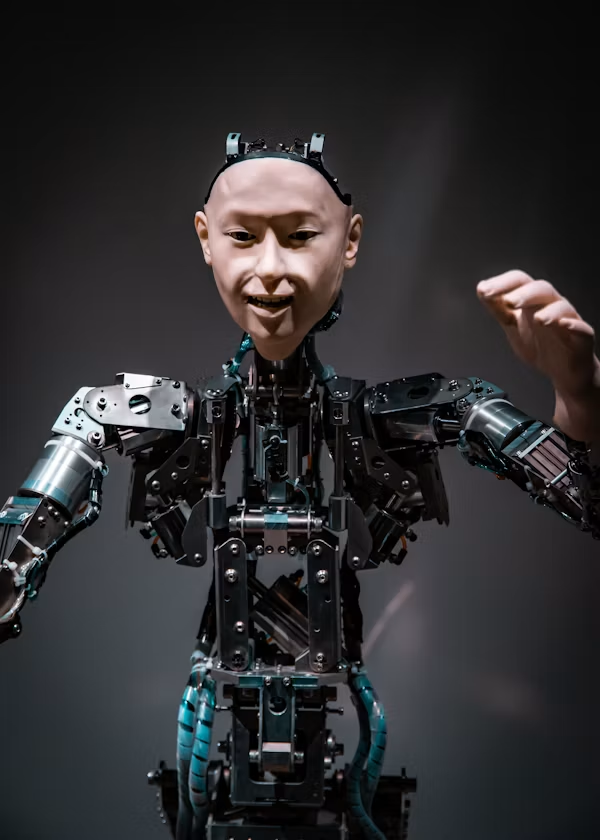
Humanoid robots in industries are rapidly shifting from experimental systems to practical business solutions across global sectors.
What Are Humanoid Robots?
Humanoid robots are advanced machines designed to look and function like humans.
They typically feature a head, torso, arms, and legs, supported by sensors, cameras, actuators, and AI systems that allow them to operate in human-built environments.
Unlike traditional industrial robots that remain fixed in one place, humanoid robots are mobile.
They can walk, lift objects, carry materials, and perform tasks across different environments without major infrastructure changes.
Their true value comes from combining physical mobility with artificial intelligence.
Instead of executing fixed instructions, they can learn, adapt, and improve performance over time. This is where Physical AI becomes critical.
NVIDIA describes Physical AI as the bridge between digital intelligence and the physical world, enabling machines to perceive, reason, and act in real environments.
This combination is what makes humanoid robots so transformative across industries.
Why 2026 Marks a Turning Point for Humanoid Robots in Industries
The year 2026 represents a major acceleration point for humanoid robotics for several structural reasons.
1. Artificial Intelligence has matured
Modern AI systems can now process language, recognize objects, and make decisions in real time with significantly improved accuracy. This allows robots to operate in unpredictable environments.
2. Falling hardware costs and scaling costs
Advances in robotics hardware, sensors, and cloud computing are reducing the cost of deployment, making enterprise robotics more accessible beyond large tech companies.
3. Global labor shortages
Many industries are struggling to fill repetitive and physically demanding roles. Robotics is becoming a practical solution rather than an experimental one.
4. Productivity pressure across industries
Companies are under pressure to deliver faster, reduce costs, and improve efficiency. Automation is becoming a competitive necessity.
Research from McKinsey highlights that early adopters of automation and robotics tend to achieve significant productivity gains and long-term operational advantages.
Together, these forces are pushing humanoid robots from pilot projects into real business operations.
Below are the five key industries where humanoid robots are expected to have the most significant impact.
Industry 1: Manufacturing
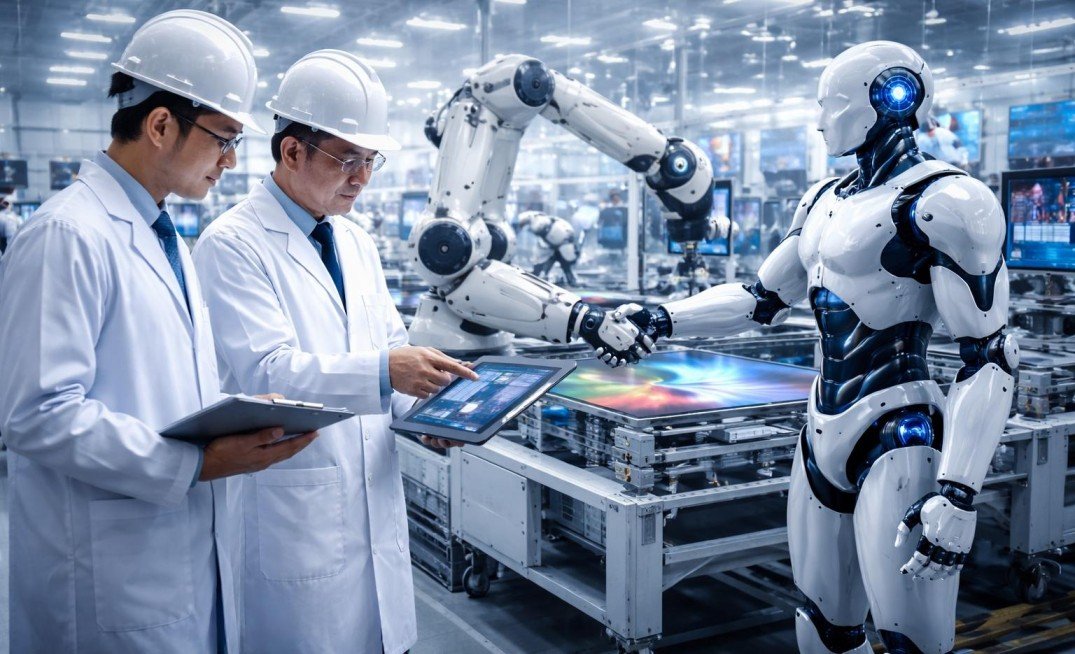
Manufacturing remains the most advanced sector for robotics adoption, but humanoid robots introduce a new level of flexibility.
The impact of humanoid robots in industries is most visible in manufacturing, where automation is already advanced.
Smart factories with adaptive robots
Instead of using fixed-purpose machines, manufacturers can deploy humanoid robots that move across production lines and perform multiple tasks.
Tesla’s Optimus, Figure AI’s humanoid systems, and Boston Dynamics’ Atlas demonstrate how robotics is evolving from automation to intelligent physical labor.
Key applications in manufacturing
Humanoid robots are increasingly used for:
- Precision assembly tasks
- Product inspection and quality control
- Material handling and transport
- Equipment monitoring and support
These systems reduce production errors while improving consistency and speed.
Human-robot collaboration
The future of manufacturing is not replacement but collaboration. Humans focus on decision-making and complex problem-solving, while robots handle repetitive and physically demanding tasks.
This hybrid model improves safety, reduces fatigue, and increases productivity in smart factories.
Industry 2: Healthcare
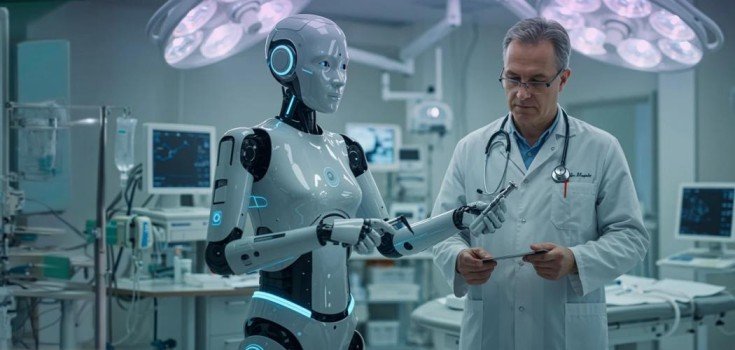
Across global sectors, humanoid robots in industries are beginning to support healthcare systems under growing pressure.
Healthcare systems worldwide are under pressure from rising patient numbers and workforce shortages. Humanoid robots are emerging as support systems for medical teams.
Supporting hospital operations
Robots can handle non-clinical but essential tasks such as:
- Transporting medical supplies
- Delivering medications
- Moving equipment between departments
- Assisting with sanitation processes
This allows healthcare professionals to focus more on patient care.
Read More: 5 Ways Robotics Can Revolutionize Healthcare
Elderly care and assisted living
As global populations age, demand for elderly care is increasing rapidly.
Humanoid robots can support patients by:
- Reminding them about medication
- Assisting with mobility support
- Providing basic companionship and monitoring
Agility Robotics’ Digit has demonstrated how humanoid systems can operate in logistics-style environments similar to hospital workflows, supporting efficiency in care systems.
Hospital efficiency improvement
Automation helps reduce delays, improve inventory tracking, and streamline hospital logistics, ultimately improving patient outcomes. The adoption of humanoid robots in industries is accelerating as companies seek efficiency, automation, and scalability.
Industry 3: Warehousing and Logistics
Warehousing and logistics are among the fastest-growing areas for the adoption of humanoid robotics due to global e-commerce expansion.
Warehouse automation in action
Humanoid robots can perform tasks such as the following:
- Loading and unloading goods
- Moving inventory across warehouse zones
- Scanning and tracking products
- Organizing storage systems
This reduces physical strain on workers while improving operational speed.
Smarter inventory management
Using computer vision and AI, robots can detect misplaced items, monitor stock levels, and reduce human error in inventory systems.
Real-world adoption trends
Companies like Agility Robotics are actively testing humanoid systems like Digit in warehouse environments, demonstrating real-world viability in logistics operations.
Impact on logistics.
With increasing demand for fast delivery, automation helps companies scale operations without a proportional increase in workforce costs.
Industry 4: Retail and Customer Service
Retail is undergoing rapid transformation driven by digital expectations and changing consumer behavior.
Enhancing customer experience
Humanoid robots can assist customers by:
- Guiding them through stores
- Answering product-related questions
- Providing personalized recommendations
- Supporting checkout processes
This improves customer satisfaction while reducing staff workload.
Improving store operations
Retail workers spend significant time managing inventory and restocking shelves.
Robots can automate these repetitive processes, allowing staff to focus more on customer engagement.
Retail automation trend
Retail automation is not about removing humans. It is about improving efficiency behind the scenes while keeping customer interaction human-centered.
Industry 5: Hospitality and Service Industries
Hospitality depends heavily on speed, service quality, and customer experience, making it a strong candidate for humanoid robotics.
Hotels and restaurants
Humanoid robots can assist with:
- Room service delivery
- Guest check-in support
- Luggage handling
- Concierge assistance
This reduces wait times and improves consistency in service delivery.
Airports and transport hubs
In busy environments like airports, robots can guide passengers, provide real-time information, and assist with navigation in multiple languages.
Public venues and entertainment spaces
Museums, stadiums, and convention centers are experimenting with service robots to enhance visitor experience and provide interactive assistance.
Benefits of Humanoid Robots in Industries
The adoption of humanoid robots brings measurable advantages across sectors:
- Increased productivity and efficiency
- Improved workplace safety
- Reduced labor shortages
- Faster operational workflows
- 24/7 operational capability
- Better consistency in task execution
- Enhanced customer experiences
These benefits are driving steady adoption across global industries.
Challenges Businesses Must Overcome
Despite their advantages, humanoid robots still face important challenges. High upfront costs remain a barrier for small and medium businesses.
In addition, companies must address cybersecurity risks, AI governance, and ethical concerns around automated decision-making.
Workforce adaptation is also critical. Employees need proper training to work alongside intelligent machines effectively.
Finally, regulatory frameworks are still developing, meaning responsible deployment is essential for long-term success.
The Future of Robotics: Humans and Robots Working Together
The future of robotics is not about replacing humans. It is about enhancing human capability.
Humans bring creativity, emotional intelligence, and critical thinking. Robots bring precision, endurance, and consistency.
As Physical AI continues to evolve, humanoid robots will become more capable of learning complex tasks and adapting to dynamic environments.
Read more: Exploring the Latest Trends in Artificial Intelligence and Machine Learning
The most successful organizations will be those that embrace collaboration between humans and intelligent machines rather than viewing automation as a replacement.
As humanoid robots in industries continue to evolve, their role in daily operations will expand significantly across industries.
Conclusion
Humanoid robots are no longer theoretical concepts. They are becoming practical tools actively reshaping global industries.
Manufacturing, healthcare, logistics, retail, and hospitality are already experiencing early transformation, and this shift is accelerating rapidly.
As artificial intelligence, robotics automation, and Physical AI continue to advance, the future of work will be defined by collaboration between humans and intelligent machines.
Organizations that adapt early will not just improve efficiency; they will gain a long-term competitive advantage in a rapidly changing global economy.