
The Lagos Life game has gone from launch to more than one million players in just four days, and it is already trying to turn that audience into an advertising business.
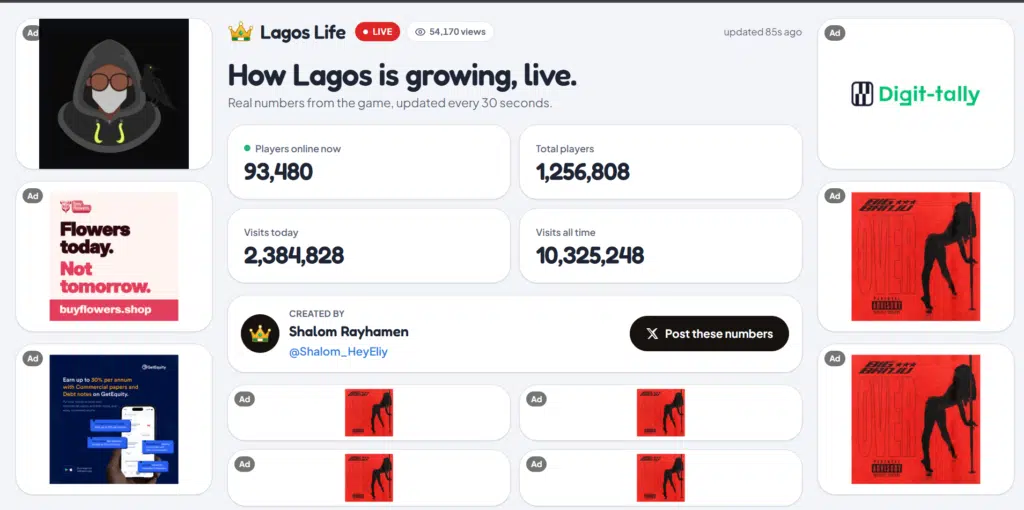
The Lagos Life game, a free life-simulation game set in a virtual Lagos, launched on October 1, 2026. By October 5, its public dashboard had passed 1.2 million total players and recorded more than 9.6 million visits.
The figures come from Lagos Life’s own dashboard and have not been independently verified, so they should be treated as self-reported figures. Even with that caveat, the speed of the game’s reported growth is striking.
But the player count is only part of the story. Lagos Life is also building advertising into its virtual city, giving businesses a way to put their brands in front of players.
Lagos Life Game Crossed 1 Million Players in Four Days
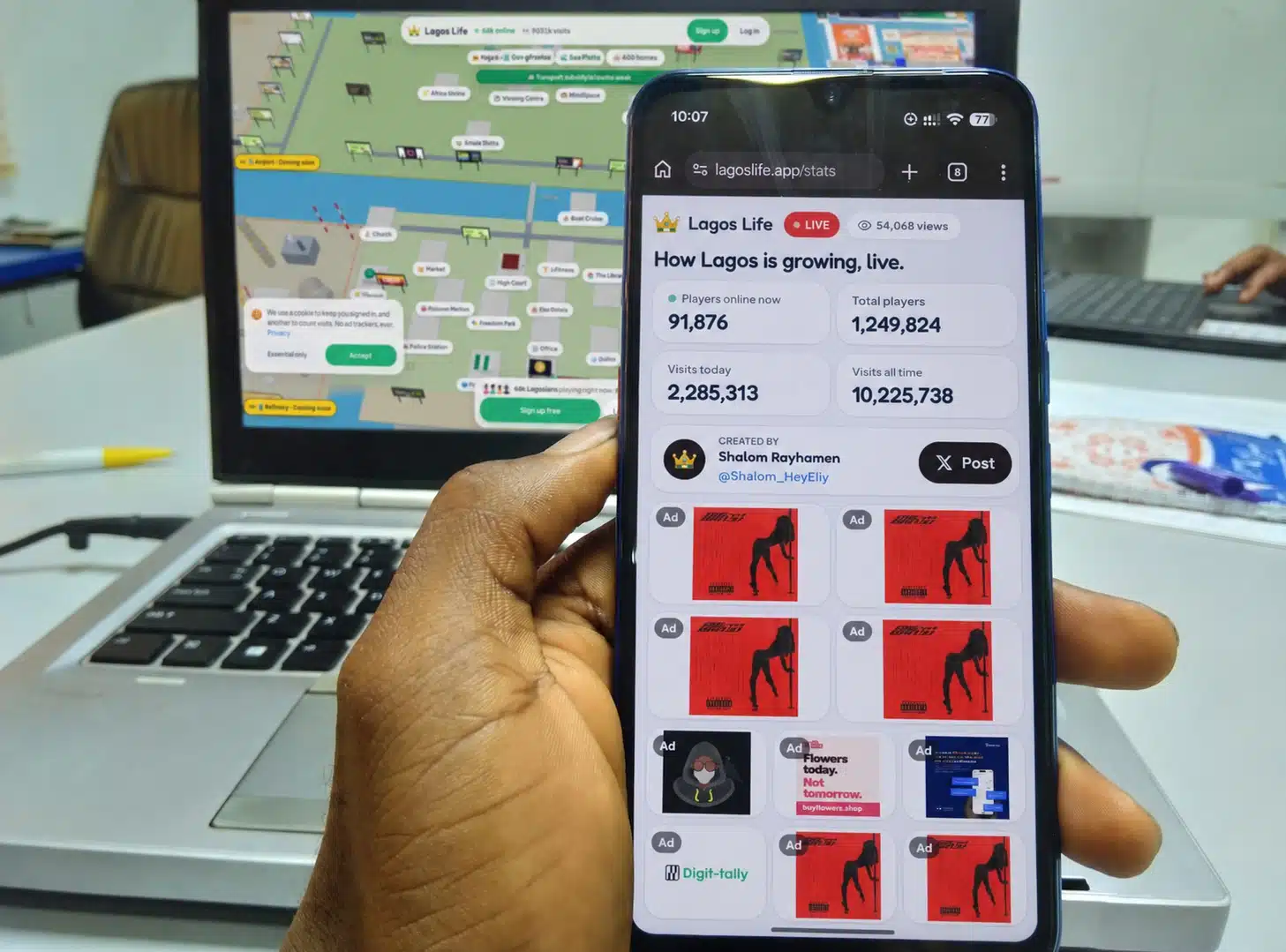
Created by Nigerian developer Shalom Rayhamen and operated under Eliy, Lagos Life is a browser-based life-simulation game built around a virtual version of Lagos.
Players create characters, work virtual jobs, manage money, pay rent, socialize, and explore different parts of the city.
Unlike many games, Lagos Life does not require players to download an app or own a gaming console. It can be accessed through a web browser, lowering the barrier to trying it.
That accessibility appears to have helped it spread quickly. Techpoint Africa reported on October 5 that Lagos Life had crossed one million players within four days of launch. Its official statistics page has since moved beyond that milestone.
Why Is Lagos Life Growing So Quickly?
Part of the Lagos Life game’s appeal is that it feels familiar. Instead of putting players in a completely fictional world, the game recreates aspects of everyday life in Lagos.
Players encounter familiar locations, social experiences, and economic challenges inside a virtual environment. That gives the game a cultural advantage.
A Nigerian player does not have to learn an entirely unfamiliar world before understanding what the game is trying to represent. The setting itself is part of the attraction.
The browser-based format also matters. Someone with a smartphone or computer and an internet connection can enter the game without first going through an app store download.
There is also a social component. Lagos Life is designed as a shared online environment, meaning players can interact with other people rather than simply controlling a single-player character.
Together, those factors give the game several ways to spread: it is accessible, recognisably Nigerian, and built around social interaction.
Lagos Life Is Selling Advertising Inside Its Virtual City
This is where the story becomes particularly interesting for businesses.
Lagos Life has created advertising spaces inside its virtual environment. Businesses can purchase virtual billboards and sea plots, with advertisements capable of linking players to external websites or social media pages.
Its current advertising page lists a billboard at ₦50,000 for seven days, while a Sea Plot costs ₦18,000 for seven days. Advertising beside the game’s live statistics is listed at ₦100,000 for seven days.
The page currently lists 38 billboard spaces. If every billboard were sold at the listed ₦50,000 weekly rate, that would amount to ₦1.9 million in potential gross billboard sales for seven days.
That is only a theoretical calculation, however. It does not mean Lagos Life is currently earning ₦1.9 million per week. The developer has not publicly disclosed billboard occupancy, total advertising revenue, operating costs, or profit.
The significance is the model itself. The Lagos Life game is also testing whether its virtual audience can become a viable advertising market.
From Virtual Lagos to Digital Real Estate
The concept is not entirely new. Websites sell advertising space around content. Social platforms sell access to audiences. Sports venues sell sponsorship placements.
Lagos Life is applying a similar idea inside a game. Instead of seeing a banner beside an article or an advert in a social media feed, players encounter brands while moving through the virtual city.
For Nigerian businesses, that could eventually become another way to reach a locally relevant online audience.
The official advertising page allows businesses to submit advertising material and pay for placements, although availability and pricing can change as the platform develops.
Lagos Life’s terms also place restrictions on what can be advertised, including misleading or illegal products and services.
What Lagos Life Means for Nigerian Game Developers
The bigger lesson may not be the one-million-player figure alone.
Lagos Life shows that a Nigerian developer can build a digital entertainment product around local culture and potentially reach a large audience without relying on a traditional console or app-store model.
That matters for Nigeria’s digital economy, where gaming, online communities, and other digital products are becoming part of a broader technology market.
Lagos Life is now testing whether that combination can work at scale.
For other Nigerian developers, the opportunity is worth watching. A locally familiar setting can be more than a creative decision; it can become part of a product’s distribution strategy.
The Harder Test Is Keeping the Players
Getting a million people to try a game is one challenge. Giving them a reason to return is another.
The Lagos Life game now has to keep its growing player base engaged while maintaining the infrastructure needed to support a large online community.
The advertising model faces a similar test. A large audience may attract advertisers initially, but businesses will eventually want to know whether those placements generate meaningful attention, clicks, or customers.
That means Lagos Life has two groups to keep interested: players who want to keep playing and businesses that want to keep paying.
Its reported player growth is therefore only the beginning of the business experiment.
What Happens Next for Lagos Life?
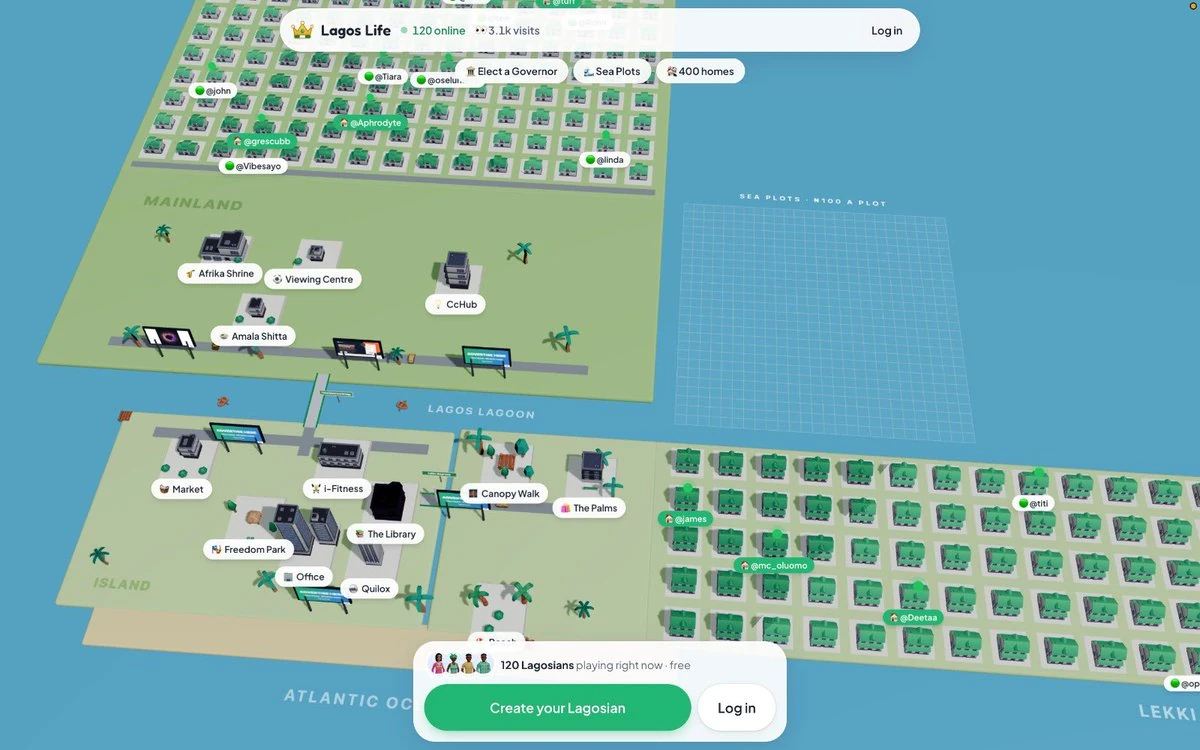
Lagos Life has already shown that a Nigerian-made browser game can attract significant attention in a very short period. The next question is whether that attention can become sustainable.
That will depend on how well the game retains players, how its virtual world develops, and whether businesses see enough value in advertising inside it.
If it succeeds, the Lagos Life game could become more than a viral Nigerian browser game. It could offer an example of how African developers can combine local culture, online communities, and advertising to build digital products.
For now, the one-million-player milestone is the headline, but the more interesting story may be what Lagos Life does with all those players.