
The Dangote IPO has barely opened, but investors have already put more than ₦10 billion into the landmark share offer, giving the refinery a strong start as it seeks to raise about ₦2.15 trillion from the public.
The Dangote Petroleum Refinery and Petrochemicals IPO opened on September 14, offering 4.1 billion shares at ₦525 each. The offer will run until October 13, with investors able to subscribe for as little as 10 shares, worth ₦5,250. The early demand is not surprising. Dangote Refinery has become one of Nigeria’s most closely watched industrial projects, and its financial performance has changed dramatically over the past year.
In the first half of 2026, the refinery reported $1.82 billion in net profit on revenue of more than $13 billion, compared with a $476 million loss in the same period of 2025.
That turnaround gives investors plenty to be excited about, but another number deserves just as much attention.
At the IPO price, Dangote Refinery is seeking a valuation of roughly $49 billion to $50 billion.
So while investors are clearly interested in owning part of the refinery, the bigger question is whether the business can grow enough to justify the expectations already priced in.
The Dangote IPO Has Already Attracted Billions of Naira
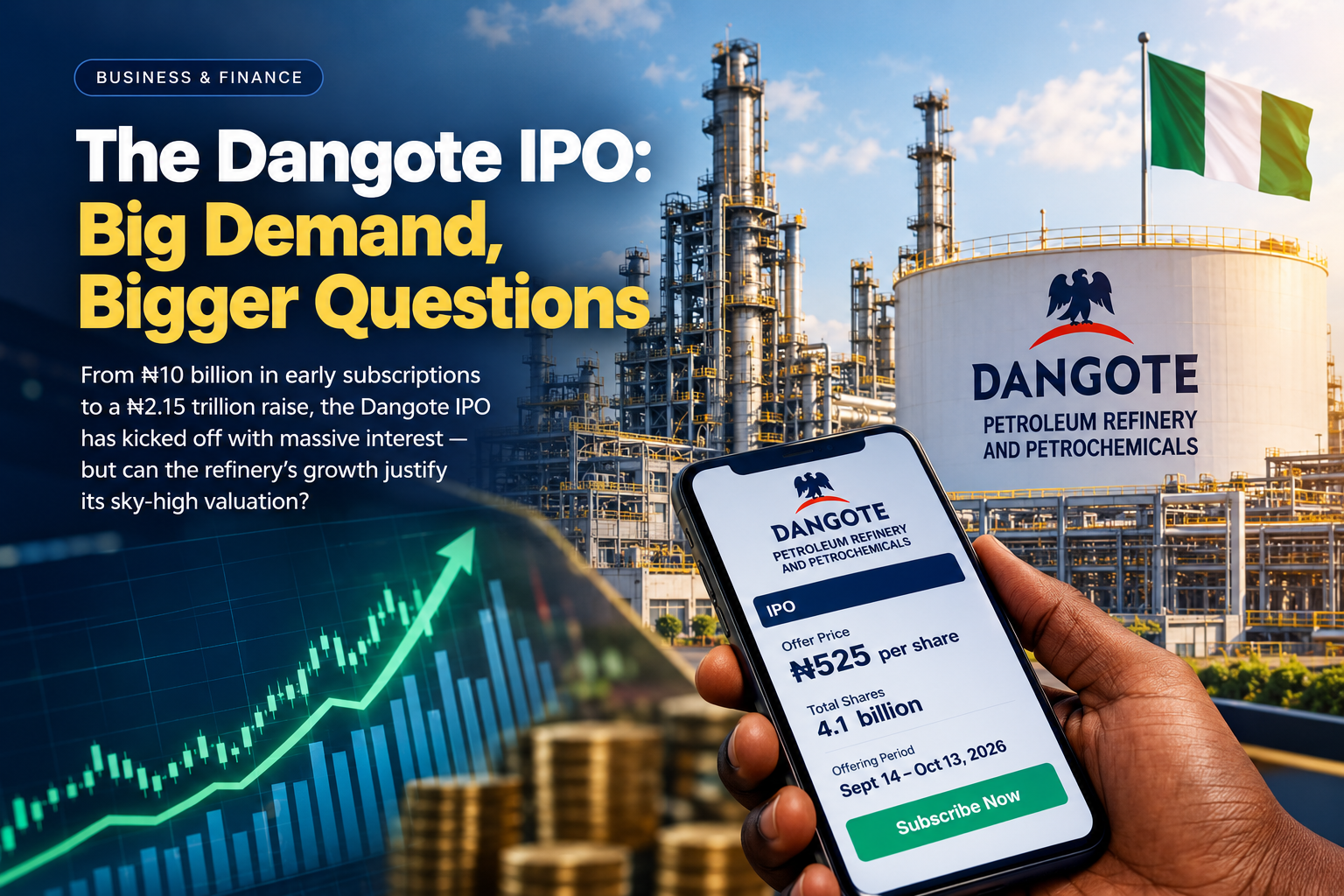
The response to the IPO was immediate. Within hours of the offer opening on September 14, NGX chairman Umaru Kwairanga said more than ₦10 billion had already been subscribed.
Access Holdings chairman Aigboje Aig-Imoukhuede also said billions of naira had been subscribed by thousands of investors within minutes or less than an hour of the offer opening.
That gives the Dangote IPO something that many Nigerian stock markets struggle to generate: mass public attention. The offer is also deliberately designed to reach ordinary investors.
With a minimum subscription of 10 shares, Nigerians can participate with ₦5,250 before applicable charges. The company is targeting up to 10 million shareholders, making retail participation a major part of the offer.
The Securities and Exchange Commission has approved the offer and has advised investors to use only officially designated subscription channels and verify any platform before providing personal or financial information.
But strong demand during the opening days does not automatically mean the shares are cheap, that is where the story gets more interesting.
Why Investors Want a Piece of Dangote Refinery
There are several reasons the Dangote IPO has generated so much interest. The first is the size of the business.
Dangote Refinery is already one of the world’s largest single-train refineries. Its current nameplate capacity is around 700,000 barrels of crude oil per day, giving it the ability to operate on a scale few African refineries can match.
The second reason is profitability.
For years, the refinery was largely a story about what it could eventually become. Investors and Nigerians watched the construction, commissioning, and gradual ramp-up of the massive Lagos facility. That story has now changed.
The refinery is generating substantial revenue and, more importantly, substantial profit. Its $1.82 billion first-half profit represents a dramatic turnaround from the loss recorded a year earlier.
The third reason is its growing position in international fuel markets. Dangote Refinery has been exporting refined products, including diesel and jet fuel, and has benefited from tight global fuel markets.
Reuters reported that the refinery exported about 80,000 barrels per day of jet fuel during the second quarter of 2026 and became Europe’s largest jet-fuel supplier during the period.
That international reach matters because the refinery is no longer simply a Nigerian fuel-supply story; it is becoming an African and global refining business.
Dangote Refinery’s Profit Has Changed the IPO Story
The most important development for potential investors may be the refinery’s financial turnaround. In H1 2025, Dangote Refinery recorded a loss of about $476 million.
A year later, it moved to $1.82 billion in net profit. Revenue during the first six months of 2026 exceeded $13 billion.
That is a huge change in a relatively short period; it also makes the IPO easier to understand.
Investors are not being asked to buy into a refinery that is still waiting to prove that it can operate commercially. They are buying into a business that has already demonstrated that it can generate significant earnings.
However, one strong six-month period should not be treated as a guarantee of future performance. The refinery benefited from unusually tight global fuel markets, including disruptions to Middle Eastern supplies. Those conditions helped push diesel and jet-fuel prices higher and created an attractive environment for refiners.
If refining margins weaken, Dangote’s earnings could also come under pressure. That is why the profitability figure is important, but it is not the entire investment story.
The ₦525 Dangote IPO Price Does Not Tell the Whole Story
For someone looking at the IPO for the first time, ₦525 per share might not sound particularly expensive, but the price of one share is not enough to determine whether a company is cheap or expensive.
What matters is the value of the entire company and how that valuation compares with its earnings and future growth prospects. At ₦525 per share, Dangote Refinery is seeking an equity valuation of roughly $49 billion to $50 billion.
That is a very ambitious valuation.
Reuters Breakingviews noted that the valuation implies a premium compared with major US refining companies. The analysis said the IPO values Dangote Refinery at about 8.3 times projected 2026 EBITDA, above the multiples of large US refiners such as Valero and Phillips 66.
That does not necessarily mean Dangote Refinery is overpriced. It means investors are being asked to pay for more than the refinery’s current earnings; they are also being asked to believe in its future.
Dangote Is Betting on a Much Bigger Refinery
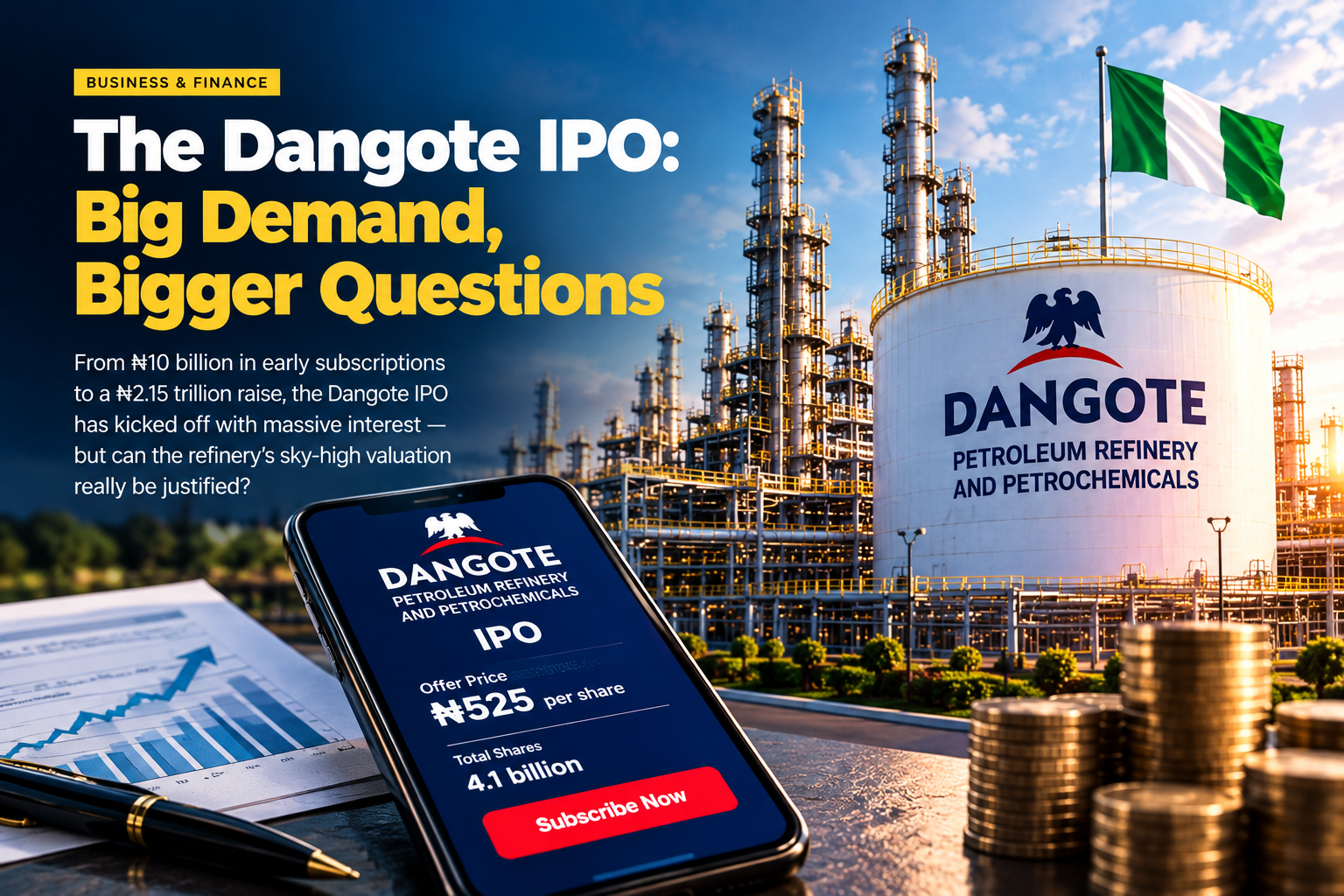
This is one of the most important parts of the IPO. Dangote is not planning to leave the refinery at its current capacity. The company plans to increase crude-processing capacity from about 700,000 barrels per day to 1.4 million barrels per day, with the expansion expected to require billions of dollars in investment. Reuters puts the planned expansion investment at about $14.3 billion.
If successful, the expansion would make Dangote Refinery one of the world’s biggest refining operations, and that future capacity is part of what investors are effectively buying into today.
The logic is straightforward. More capacity could mean more crude processed, more refined products sold, and potentially more revenue, but it also introduces another layer of risk.
Expansion projects require huge amounts of capital and have to be completed on time and within reasonable costs. The refinery will also need reliable crude supplies and favorable enough refining margins to make the additional capacity worthwhile.
So the Dangote IPO is partly a bet on the refinery that exists today and partly a bet on the refinery Dangote wants to build tomorrow.
The Biggest Question: Can the Good Times Last?
This is where investors need to look beyond the excitement surrounding the IPO. Dangote Refinery has several advantages.
It operates at an enormous scale and has access to international markets.
It has already demonstrated strong profitability, and its expansion plans could significantly increase its earnings capacity, but refining is also a cyclical business.
Fuel prices change, refining margins change, crude oil prices change, global supply changes, and even geopolitical events can suddenly create shortages or eliminate them.
The strong market conditions that helped Dangote generate its record first-half performance may not last forever. Reuters has also identified potential risks around regulation, foreign-exchange restrictions, and delays to the planned expansion.
That leaves investors with a difficult calculation, and they have to decide whether the refinery’s future growth is strong enough to justify paying a premium valuation today.
What the Dangote IPO Could Mean for Nigeria’s Stock Market
The IPO could be significant even beyond Dangote Refinery. Nigeria’s capital market has spent years trying to bring more individual investors into the stock market.
The Dangote IPO gives that effort a major boost because of the company’s visibility and the relatively low minimum investment. Millions of Nigerians who may never have considered buying shares in a major industrial company now have the opportunity to participate with a minimum subscription of ₦5,250.
The scale of the transaction is also important. The IPO is seeking about $1.6 billion and is being described as Africa’s largest-ever IPO. Its eventual listing could significantly increase the size and visibility of Nigeria’s stock market.
That could have a wider effect.
If the offer succeeds and retail participation remains strong, other large Nigerian businesses may become more interested in using the public market to raise capital and broaden ownership. NaysBlog previously examined the potential OPay NGX listing and what another major Nigerian company entering the public market could mean for investors.
The Dangote transaction is much larger, but both developments point to the same broader question: can Nigeria build a deeper stock market where more of the country’s biggest businesses are publicly owned?
Why the Dangote IPO Matters Beyond Investors
There is also a bigger industrial story behind the IPO. Dangote Refinery was built to change Nigeria’s relationship with refined petroleum products.
Nigeria has historically depended heavily on imported refined fuel despite being one of Africa’s biggest oil producers. The Dangote refinery has begun changing that equation by producing fuel domestically and exporting refined products to other markets.
The IPO now takes that story one step further. A project that was once largely associated with one of Africa’s wealthiest businessmen is being opened to public ownership.
That is why the transaction has attracted attention far beyond the usual investment community. The development also comes as Nigeria continues to pursue a much larger digital and economic transformation, with major private-sector investments playing an increasingly important role in that story. Read more about Nigeria’s $1 trillion economy.
What Investors Should Watch Next
The Dangote IPO is scheduled to remain open until October 13, 2026. That means the story is only beginning.
Over the coming weeks, several developments will matter.
Subscription levels: The initial ₦10 billion response is encouraging, but the final level of demand will tell a much bigger story.
Profitability: Investors will want to know whether the refinery can maintain strong earnings after the current period of unusually tight fuel markets.
Expansion: The planned move towards 1.4 million barrels per day will be critical to the company’s long-term growth story.
Refining margins: Strong margins helped drive the recent profit surge. A major decline could change the earnings picture.
Regulation and FX: Changes in Nigeria’s operating environment could affect the company’s costs and expansion plans.
Post-IPO performance: Once the shares begin trading, the market itself will provide another verdict on whether the IPO valuation was justified.
The company is therefore likely to remain a major Nigerian business story well after the subscription window closes. Want to read more about major business and technology developments in Nigeria? Explore more stories and analysis on NaysBlog.
So, Is the Dangote IPO Worth the Hype?
There is a strong case for the excitement. Dangote Refinery has moved from being an enormous construction project to a major operating business generating billions of dollars in revenue and profit.
It has reached large-scale production, entered international fuel markets, and is planning to double its capacity. Those are significant achievements, but there is also a reason for investors to be cautious.
The IPO valuation is already high, meaning a significant amount of future growth appears to be reflected in the price. If refining margins remain strong and Dangote successfully executes its expansion plans, the valuation could become easier to justify.
If market conditions deteriorate or expansion takes longer than expected, investors could find themselves paying a premium for growth that takes longer to arrive. That is ultimately what makes the Dangote IPO interesting.
The question is no longer whether Dangote Refinery is a major Nigerian business. It clearly is.
The real question is how much future growth investors are already paying for at ₦525 per share. For now, the early response suggests Nigerians are willing to bet on Dangote’s future.
The refinery’s performance over the next few years will determine whether that confidence was justified.
Note: This article is for informational purposes only and should not be considered financial advice. Prospective investors should review the approved IPO documents, understand the risks, and use only officially approved subscription channels. The Securities and Exchange Commission has specifically warned investors to verify subscription platforms and avoid transferring funds to unauthorized individuals or entities.