
Internet in Africa Is Changing: What Comes After Mobile Data?
Internet in Africa is entering a new phase. For years, the easiest way to describe connectivity across the continent was simple: get a mobile phone, buy data, and go online.
That model is still hugely important, but the next stage of Africa’s internet growth is becoming more complicated.
Mobile broadband networks already reach most of the population, yet millions of people remain offline or cannot afford to use the internet regularly. The GSMA estimates that about 63% of Africans live within mobile broadband coverage but do not use mobile internet, compared with a coverage gap of about 9%.
That is changing what the connectivity race is about. Instead of simply building more mobile coverage, operators, governments, and infrastructure companies are looking at 5G fixed wireless access, fibre, public Wi-Fi, satellite connectivity, and targeted data-free services to solve different parts of the problem.
So, what comes after mobile data?
Mobile Data Built Africa’s Internet. But It Has Limits
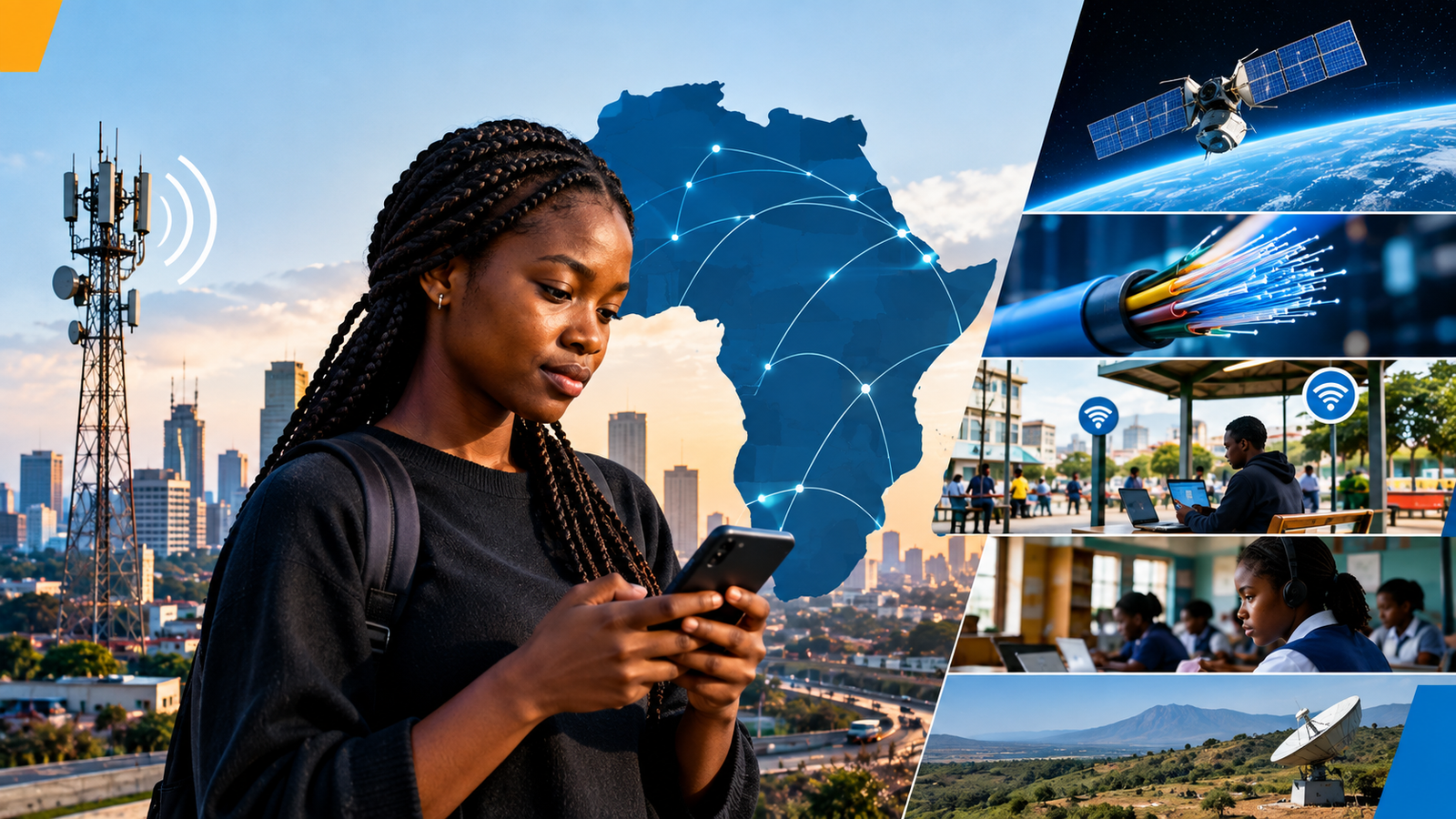
Mobile networks remain the backbone of internet in Africa, allowing people to connect without waiting for fixed broadband to reach their homes.
They have allowed people to connect without waiting for fixed broadband to reach their homes. Smartphones have also become the main gateway to banking, social media, entertainment, education, work, and commerce.
The mobile industry is not disappearing either. According to the GSMA, mobile technologies and services contributed about $240 billion to Africa’s economy in 2025, equivalent to 7.8% of the continent’s GDP. That contribution is expected to reach $290 billion by 2030.
The bigger problem is what happens after a network reaches someone. A person may have mobile coverage but still be unable to use the internet consistently because a smartphone is too expensive, data costs too much, digital skills are limited, or useful online content is difficult to access.
That is why Africa’s connectivity problem is increasingly becoming a usage problem, not just a coverage problem. The GSMA says affordability remains the biggest barrier to mobile internet adoption, alongside issues such as digital skills and access to relevant content.
And the divide is even more obvious outside major cities.
The International Telecommunication Union found that in 2024, about 57% of Africa’s urban population used the internet, compared with only 23% of its rural population. That gap explains why simply putting another mobile tower somewhere is not always enough.
The Next Connectivity Battle Is About the Last Mile
One of the biggest changes taking place is the growth of 5G Fixed Wireless Access, or FWA. Instead of running fibre cables all the way into a home, FWA can use a nearby mobile network to provide fixed broadband through specialized equipment installed at a home or business.
It gives operators another way to connect locations where traditional fibre deployment may be too expensive or difficult. A September 2026 report by TechAfrica News said 40 operators across 37 African markets had launched commercial 5G FWA services by May 2026.
Nigeria is part of that shift. Airtel Nigeria, for example, launched its SmartConnect 5G ODU Router in 2025, using outdoor equipment to improve signal reception and provide fixed wireless internet to homes.
The attraction is straightforward: operators can use existing mobile infrastructure rather than digging new trenches for every connection.
But FWA is not a fibre replacement. Fibre still has major advantages, especially where high-capacity, reliable connections are needed. Wireless networks also have limits because users share available spectrum. As more homes consume more data, congestion can become a problem.
The likely future is therefore not fibre versus 5G. It is fibre plus wireless.
Public Wi-Fi Is Becoming Another Piece of the Puzzle
There is also another way to bring people online: don’t necessarily connect every person individually. Connect the place where people gather.
Public Wi-Fi can give people access to the internet in schools, transport hubs, markets, community centers, and other public spaces without requiring everyone to maintain a large personal mobile data balance.
That model is already appearing in different parts of Africa. In Nigeria, for instance, a planned public Wi-Fi rollout announced in 2026 is expected to target major cities, with Lagos and Abuja among the initial locations.
Kenya is also exploring partnerships to expand public Wi-Fi as part of efforts to make internet access more affordable and available in public spaces and underserved communities.
And in Ghana, a district-level initiative began installing free Wi-Fi for educational purposes in communities in the Volta Region in September 2026.
Public Wi-Fi is becoming an important part of internet in Africa, particularly in places where people cannot afford constant mobile data or where households share limited connectivity.
The bigger idea is that internet access does not always have to mean every user buying a separate data bundle.
Nigeria Is Trying Something Different: Data-Free Education
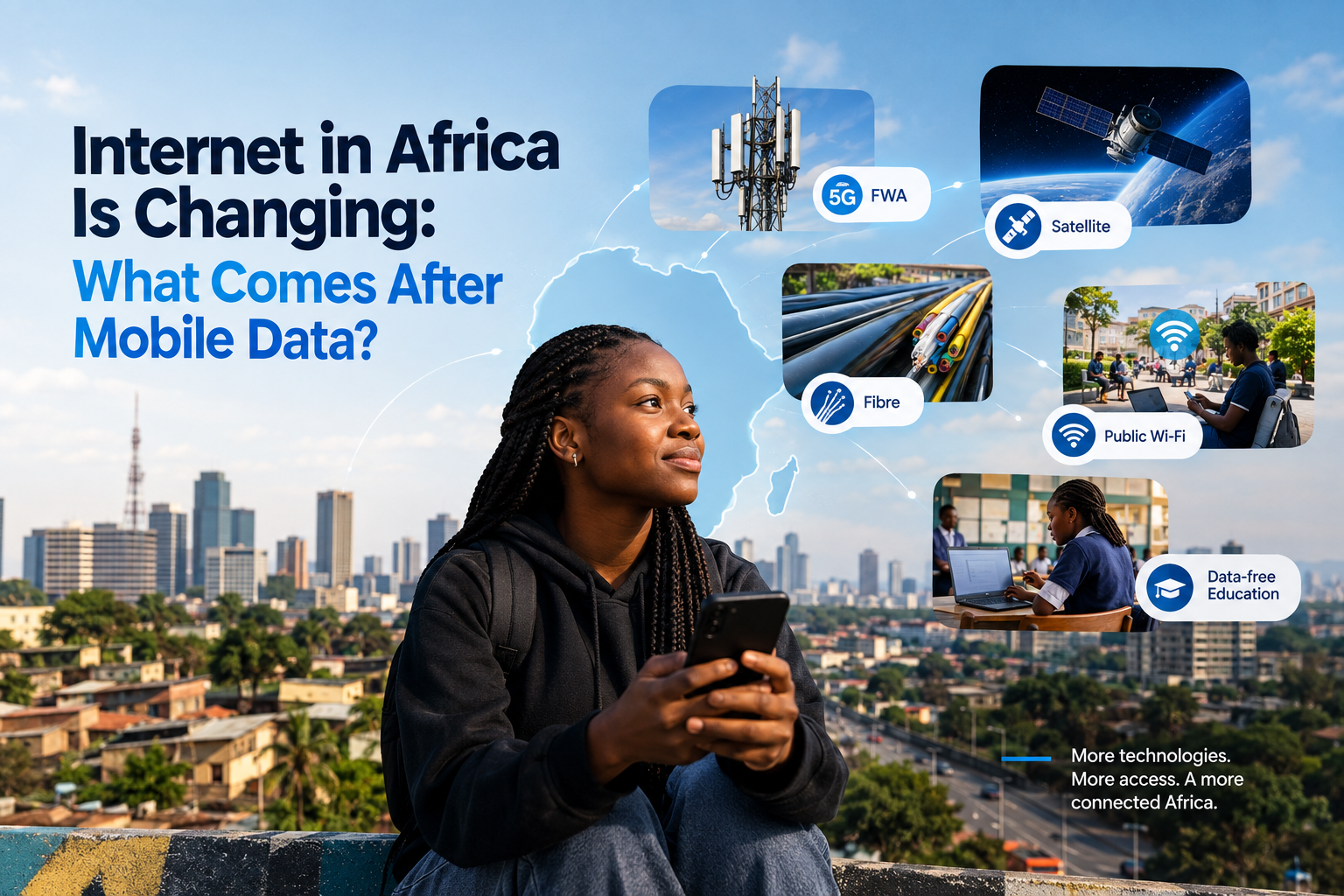
Nigeria is also experimenting with a more targeted approach to affordability. On September 10, the Nigerian Communications Commission launched an initiative that gives eligible users free access to designated educational platforms and content.
Under the operator-sponsored model, users can receive up to 100MB of free data each day for approved educational platforms. The initiative is expected to begin on October 1, 2026. The logic is important.
Instead of making all internet access free, the policy targets a specific activity where data costs can prevent people from using online resources: education.
That could allow a student to access approved learning materials without spending part of their regular data allowance on every lesson, resource, or educational website. It also shows how the future of connectivity may involve more than infrastructure.
Policy can determine what people can actually afford to do online, and that matters as Nigeria’s digital economy continues to expand.
Satellites Could Change Where Internet Works
Then there is satellite connectivity. For communities where laying fibre is difficult and terrestrial mobile infrastructure is expensive, satellites can provide another route to the internet.
This is particularly relevant in remote and underserved areas where geography makes traditional infrastructure difficult to deploy, but satellite connectivity should not be presented as the technology that will replace mobile networks or fibre.
Africa will need all of them.
Mobile networks remain essential for everyday smartphone access. Fibre provides the high-capacity backbone needed to move enormous amounts of data. FWA can provide a faster last-mile option in places where fibre is difficult to deploy. Satellites can help reach locations where terrestrial infrastructure is harder to justify.
That is why satellite-to-phone services are attracting so much attention across Africa.
The question is gradually moving from “Can this place get internet?” to “Which technology is the most practical way to connect it?”
Fibre Still Matters
It would be a mistake to look at the rise of wireless and satellite connectivity and assume fibre is becoming irrelevant. The opposite may be happening. Behind mobile networks, cloud services, data centres, broadband connections, and digital businesses is a huge infrastructure layer that ordinary users rarely see.
In September 2026, African digital infrastructure company WIOCC announced a $300 million investment from Africa Finance Corporation and Vision International Investment Company.
The company said the funding would support data center capacity, expansion of its terrestrial fibre network, and additional subsea infrastructure. That matters because a faster internet experience does not depend only on the connection between a person’s phone and a nearby tower.
There must also be enough capacity behind that connection. As more Africans stream video, use cloud services, work online, make digital payments, and use increasingly data-heavy applications, the networks carrying that traffic need to expand too.
So while the last mile may become more wireless, the infrastructure underneath Africa’s internet will still depend heavily on fibre and subsea cables.
The Next Goal Is Not Just Getting Online
This is probably the most important change in Africa’s connectivity story. For years, the headline question was, “How many people can we connect?”
That question still matters. But a second question is becoming harder to ignore: What can those people actually afford to do once they are connected?
A person with a 4G signal but no affordable data is technically covered but practically disconnected. A student with a smartphone but no money for educational data still faces a barrier.
A rural community with network coverage but poor service quality may remain poorly served, and a household with one smartphone shared among several people has a very different internet experience from a household where everyone has a connected device.
That is why the next phase of internet in Africa will involve several technologies and policies working together.
The Future of Internet in Africa May Look Different
The future of internet in Africa probably will not look like one technology replacing another. Instead, it could become a mixture of systems. Mobile broadband will remain the everyday connection for hundreds of millions of people.
5G FWA can provide home and business broadband where fibre is difficult to deploy. Fibre will continue carrying enormous amounts of traffic between homes, businesses, data centres and international networks.
Public Wi-Fi can create shared access points in communities and public spaces. Satellite connectivity can extend coverage to places where terrestrial infrastructure is difficult, and policies such as Nigeria’s zero-rated education initiative can make specific types of online activity more affordable.
The challenge is making these pieces work together.
UNICEF is already looking at connectivity from that wider perspective. In September 2026, the organization invited 96 companies to bid for long-term agreements to provide reliable and affordable internet connectivity to schools, health facilities, and other places serving children across all 54 African countries.
That is a useful sign of where the conversation is heading. The future of Africa’s internet is not simply about building more networks; it is about making sure people can use those networks meaningfully, affordably, and consistently.
Mobile data helped build Africa’s digital economy. What comes next is a more complicated connectivity system, one where mobile, fibre, wireless, Wi-Fi, satellites, and policy all have a role to play.
And for millions of Africans still on the wrong side of the digital divide, that may matter more than whichever technology gets the most attention next.