
Airtel Starlink: Satellite-to-Phone Service
Airtel and SpaceX’s Starlink have taken satellite-to-phone connectivity from testing to commercial service in Africa.
On August 14, 2026, Airtel Africa commercially launched Starlink Mobile in the Democratic Republic of Congo (DRC), making it the first Airtel Africa market, and the first commercial deployment of the service on the continent where compatible smartphones can connect directly to Starlink satellites when conventional mobile coverage is unavailable.
The development could change how people stay connected in remote areas where building mobile towers is difficult or expensive. But Airtel Starlink is not simply “Starlink internet on your phone.” The service currently focuses on messaging and selected lightweight data services rather than unrestricted mobile broadband.
So, what exactly is Airtel Starlink, how does it work, which phones support it, how much does it cost, and can Nigerians use it yet?
Here’s what you need to know.
Airtel and Starlink Launch Satellite-to-Phone Service in Africa
Airtel Africa and SpaceX announced their partnership in December 2025 to introduce Starlink Direct-to-Cell connectivity across Airtel Africa’s 14 markets. The plan was designed to extend mobile coverage to areas that conventional terrestrial networks cannot easily reach.
The first commercial rollout arrived in the DRC on August 14, 2026. Airtel calls the service Starlink Mobile.
Instead of depending entirely on a nearby mobile tower, compatible phones can connect to Starlink satellites when Airtel’s terrestrial network is unavailable.
The DRC launch follows earlier testing in other Airtel markets. Airtel Africa successfully tested data and messaging with Starlink Mobile in Kenya in March 2026, while other tests have also taken place as the company prepares for wider deployment.
Airtel says expansion to additional markets will happen progressively and remains subject to country-specific regulatory approvals.
What Is Airtel Starlink Satellite-to-Phone Service?
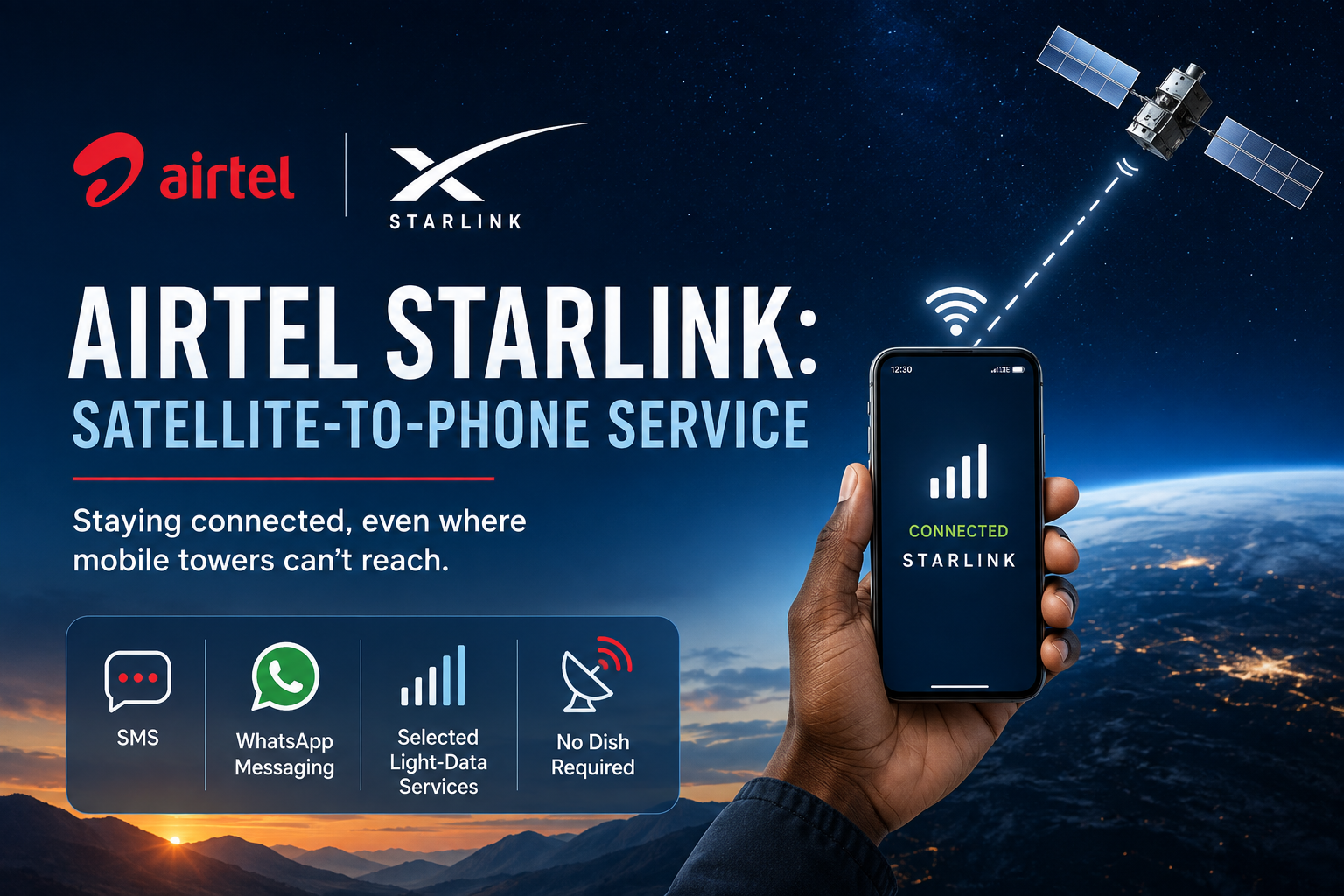
Airtel Starlink is Airtel’s satellite-to-mobile connectivity service powered by SpaceX’s Starlink Direct-to-Cell technology. The basic idea is straightforward: instead of your phone losing connectivity completely when it moves outside the reach of a mobile tower, a Starlink satellite can provide another connection path.
The satellite effectively acts as a mobile network extension in space. That is different from conventional Starlink broadband, where a customer uses a Starlink satellite dish or terminal to receive internet access.
With Airtel Starlink, the aim is to connect a compatible mobile phone directly to the satellite. Users therefore do not need to install a Starlink dish at home or carry a dedicated satellite phone.
How Does Airtel Starlink Work?
The service combines Airtel’s existing mobile network with Starlink’s satellite infrastructure. Under normal circumstances, your smartphone connects to an Airtel cell tower. The tower provides the connection between your phone and the wider telecommunications network.
But terrestrial coverage has limits.
A person travelling through a remote area, for example, could eventually move beyond the range of an Airtel tower. That’s where satellite-to-mobile connectivity is designed to help.
With Starlink Mobile, a compatible phone can connect to a Starlink satellite overhead when terrestrial Airtel coverage is unavailable. The satellite then provides the connectivity needed for the supported services.
A clear view of the sky is important for the service to work effectively.
This is one of the biggest differences between Airtel Starlink and ordinary Starlink broadband: the phone itself is the user device. Read more: How satellite internet works and why it is changing global connectivity.
There is no separate Starlink dish or satellite terminal required.
What Can You Do With Airtel Starlink?
This is where expectations need to be realistic. Airtel Starlink is currently designed primarily for basic connectivity and selected lightweight data services, rather than the full internet experience people get from a conventional broadband connection.
At the DRC launch, Airtel said the service supports:
- SMS
- Selected light-data applications
- WhatsApp messaging
The initial service is therefore more useful for staying reachable and exchanging essential information than for consuming large amounts of data.
For example, being able to send a WhatsApp message from an area without terrestrial mobile coverage could be valuable to someone travelling through a remote part of the country.
But users should not expect Airtel Starlink’s initial service to behave like a normal 4G or 5G connection. It is not currently a replacement for conventional mobile broadband.
Which Phones Support Airtel Starlink?
At the DRC launch, Airtel specified compatible LTE Android smartphones for the service. That is important because not every phone should automatically be assumed to work with Airtel Starlink.
Airtel has also indicated that Apple devices will be supported in the future, but a specific date for Apple support has not been announced. For that reason, it would be misleading to publish a large list of individual Samsung, Tecno, Infinix, Xiaomi or iPhone models unless Airtel provides an official compatibility list for the relevant market.
The safest approach for users is to check Airtel’s compatibility information when the service becomes available in their country.
Does Airtel Starlink Need a Dish?
This is one of the biggest differences between Airtel Starlink and regular Starlink internet. The satellite-to-phone service is designed to connect compatible smartphones directly to Starlink satellites. Users do not need to buy a Starlink dish, install a satellite terminal or carry a specialised satellite phone.
That makes the technology potentially much easier to deploy at the consumer level.
Someone in a remote location does not need to set up a broadband installation simply to send a message. If the person’s phone and service are supported and there is a suitable view of the sky, the satellite connection can provide the supported mobile services.
Is Airtel Starlink Available in Nigeria?
Not yet as a confirmed commercial launch. The first commercial Airtel Starlink deployment in Africa is currently in the Democratic Republic of Congo.
Airtel Africa’s broader agreement with SpaceX covers its 14 African markets, including Nigeria, but expansion is subject to country-specific regulatory approvals.
That distinction matters. Airtel Nigeria was included in the original plans for Starlink Direct-to-Cell connectivity, but that does not mean Nigerian Airtel customers can currently activate the DRC commercial service on their phones.
So, if you are searching for Airtel Starlink Nigeria, the important point as of August 25, 2026, is that there is no confirmed commercial Nigerian launch to point customers to yet.
That could change as Airtel obtains the necessary approvals and expands Starlink Mobile across its African markets.
How Much Is Airtel Starlink in Nigeria?
There is currently no confirmed Nigerian Airtel Starlink price to report because the satellite-to-phone service has not been commercially launched in Nigeria. This means users should be careful with online claims about an Airtel Starlink price in Nigeria.
The DRC launch provides a useful indication of how Airtel is approaching the service. Eligible DRC customers were offered an introductory period, after which access is tied to eligible Airtel data arrangements.
But that does not establish what Airtel Nigeria will charge if and when the service launches locally.
The Nigerian price could depend on Airtel’s commercial plans, regulatory requirements and the specific services included in the local rollout.
Until Airtel Nigeria announces those details, there is no reliable Nigerian subscription price to publish.
Airtel Starlink vs Regular Starlink Internet
Airtel Starlink and regular Starlink internet use the same broader satellite ecosystem, but they are designed for different purposes.
| Feature | Airtel Starlink satellite-to-phone | Regular Starlink internet |
|---|---|---|
| Connection | Smartphone connects to satellite | Starlink terminal connects to satellite |
| Dish required | No | Yes |
| Main device | Compatible smartphone | Starlink hardware and connected devices |
| Main purpose | Extend mobile connectivity | Broadband internet |
| Initial services | SMS and selected light-data services | Full broadband internet service |
| Rollout | Airtel market by market | Separate Starlink service availability |
The key takeaway is simple: Airtel Starlink is not the same thing as buying Starlink broadband.If you want regular Starlink broadband in Nigeria, that is a different Starlink product.
If you are outside terrestrial mobile coverage and need basic mobile connectivity, Airtel Starlink is designed for that use case.
Why Airtel Starlink Matters for Africa
The significance of Airtel Starlink goes beyond being able to send a WhatsApp message from a remote location. Africa still has large areas where extending conventional telecommunications infrastructure can be difficult because of geography, population density, power requirements, fibre availability and the cost of building and maintaining physical infrastructure.
The DRC is a particularly notable starting point because of its vast geography and difficult-to-reach areas. Satellite-to-mobile connectivity gives telecom operators another option.
Read more: How Big Tech is reshaping Africa’s digital infrastructure.
Instead of relying exclusively on the construction of additional towers, satellites can potentially extend connectivity into areas where terrestrial infrastructure has not reached.
That could have practical applications for:
- Remote communities
- Long-distance travellers
- Mining and logistics operations
- Emergency communication
- Rural businesses
- Healthcare workers operating in remote areas
- Disaster response
- People travelling through network dead zones
Techpoint Africa similarly describes the technology as an extension of the mobile network rather than a replacement for ordinary mobile broadband.
That distinction is important because the real opportunity is not necessarily to replace Airtel’s existing network. It is to fill some of the gaps that terrestrial networks struggle to cover.
What Are the Limitations of Airtel Starlink?
Despite the excitement around satellite-to-phone connectivity, the technology still has limitations.
It does not replace 4G or 5G
The current service is designed around messaging and selected lightweight applications. Users should not expect unrestricted high-speed internet simply because their phone is connected to a Starlink satellite.
Phone compatibility matters
Only supported devices can use the service. That means owning an Airtel SIM alone does not automatically make a phone compatible with Starlink Mobile.
A clear view of the sky is important
Satellite connectivity is different from ordinary terrestrial mobile coverage. Buildings, terrain and other obstructions can affect the ability of a phone to communicate with a satellite.
Availability depends on regulation
Airtel Africa has said that expansion across its markets is subject to country-specific regulatory approvals. This means the service will not necessarily become available across all Airtel countries at the same time.
The service is still developing
Airtel and Starlink have already tested data and messaging capabilities in African markets, and Airtel expects the technology to evolve. The current commercial service should therefore be viewed as an early stage of a broader satellite-to-mobile strategy rather than its final form.
What Happens Next for Airtel Starlink in Africa?
The DRC launch is likely to be only the beginning. Airtel Africa has said that the experience from the DRC will support the progressive expansion of Starlink Mobile across its other markets, subject to regulatory approvals.
The company had previously announced plans to introduce Starlink Direct-to-Cell connectivity across its 14 African markets. The rollout will therefore be worth watching in countries such as Nigeria, Kenya and other Airtel markets where coverage gaps remain an issue.
The bigger question is how far satellite-to-phone technology can progress.
If future generations of satellites deliver greater capacity and faster data services, the technology could move beyond emergency or basic messaging use and become a more meaningful complement to terrestrial mobile networks.
For now, however, the most accurate way to view Airtel Starlink is as a connectivity safety net: a way of keeping compatible mobile users connected when conventional network coverage disappears.
Conclusion
Airtel Starlink marks an important shift in how mobile connectivity could work in Africa. The DRC launch shows that a person may no longer need to be within range of a conventional mobile tower to send a message from a compatible smartphone. Instead, a Starlink satellite can provide another route to the mobile network.
But the technology is still in its early commercial phase. For now, Airtel Starlink is best understood as a satellite-powered extension of Airtel’s mobile network, not a replacement for 4G, 5G or conventional Starlink broadband.
For Nigerian users, the story is one to watch. Airtel Africa’s partnership with SpaceX includes Nigeria, but until the company confirms a local commercial launch and pricing, claims that Airtel Starlink is already available nationwide should be treated cautiously.