
Big Tech in Africa is entering a new phase, as global technology companies expand their investments in the continent’s digital infrastructure. Google, Meta, Microsoft, Amazon and Starlink are expanding different parts of Africa’s digital infrastructure, from subsea cables and cloud systems to satellite internet.
That means the story is no longer simply about who has the biggest social network or search engine. It is about who is helping build the infrastructure that allows Africa to connect to the digital economy.
For a continent where hundreds of millions of people remain offline, that investment could be transformative, but there is another question worth asking: as foreign technology giants build more of Africa’s digital infrastructure, who ultimately controls the continent’s digital future?
Why Big Tech Is Expanding Across Africa
Big Tech in Africa is becoming too important for global technology companies to ignore. The continent has a rapidly growing population, expanding digital markets and millions of consumers whose internet use is still increasing.
Fintech, e-commerce, cloud computing, artificial intelligence and digital services are also creating new opportunities for technology companies. But the biggest opportunity may be the infrastructure itself.
Africa still has enormous connectivity gaps, particularly in rural and underserved communities. That creates a market for companies capable of deploying fibre, subsea cables, cloud infrastructure and satellite networks at scale.
In other words, Big Tech in Africa is not simply expanding because the continent needs technology. It is arriving because Africa’s digital economy represents a major long-term growth opportunity.
Google Is Building More Than Search Infrastructure
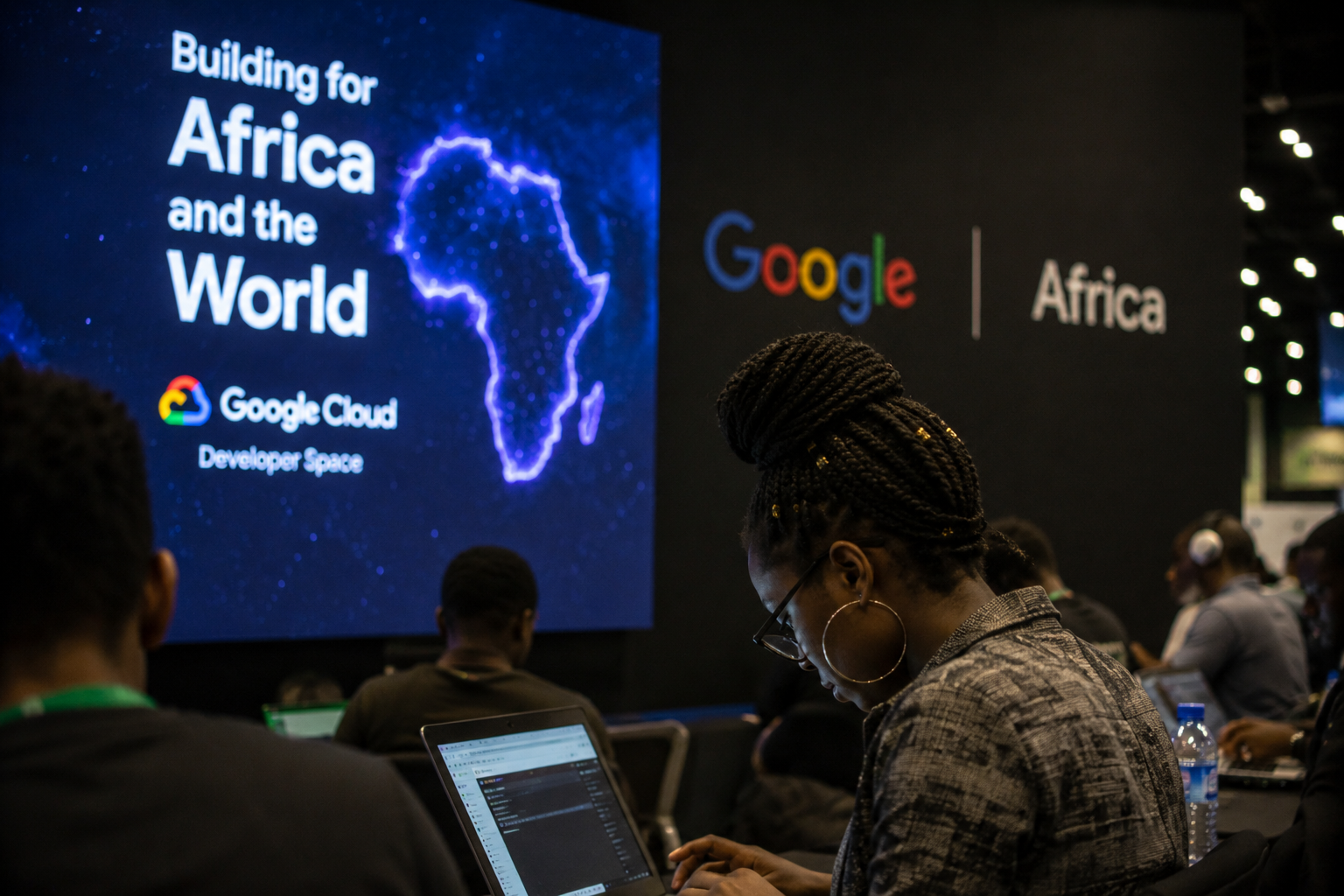
Big Tech in Africa is becoming about much more than social media and search, and Google’s strategy has moved far beyond its familiar search engine and advertising business. In 2021, the company announced a five-year, $1 billion commitment to support Africa’s digital transformation.
Google says it has now exceeded that commitment and is planning four strategic subsea cable connectivity hubs across Africa. Its infrastructure footprint includes the Equiano subsea cable, the Umoja fibre route connecting Africa directly to Australia, and a Google Cloud region in Johannesburg.
The company also says its investments have helped 100 million Africans access the internet for the first time. That matters because connectivity is becoming the foundation beneath almost everything else.

A startup cannot scale without reliable internet, a fintech company cannot serve customers without digital networks, and an AI developer cannot build sophisticated products without access to computing infrastructure.
Google’s bet, therefore, is not just on today’s African internet user. It is on the businesses and digital economies that could emerge as connectivity improves.
Meta Is Moving Deeper Into Africa’s Internet Infrastructure
Big Tech in Africa is also reshaping the continent’s internet backbone, and Meta is taking a similar approach, particularly through subsea connectivity. Its 2Africa cable system was completed in 2025, with the company describing it as the world’s longest open-access subsea cable system.
The system reaches 33 countries and is designed to connect Africa with Europe, the Middle East and Asia.
Why does that matter to ordinary internet users? Because internet access is not just about having a smartphone.
The networks carrying data need enough capacity to handle millions of simultaneous connections, and more subsea capacity can help improve the resilience and efficiency of those connections.
Meta’s growing network presence also shows how the company is becoming more deeply embedded in Africa’s internet infrastructure. The company may be best known for Facebook, Instagram and WhatsApp, but its infrastructure investments increasingly sit behind the digital experiences people use every day.
Microsoft Is Betting on Connectivity, Cloud and Digital Skills
Microsoft is approaching the Big Tech in Africa opportunity from another angle. The company says it has expanded connectivity coverage to more than 124 million people across Africa as part of its broader digital-access efforts, but connectivity is only one part of Microsoft’s strategy.
Cloud computing, cybersecurity, enterprise software and digital skills are becoming equally important as African businesses move more of their operations online.
This is particularly significant as artificial intelligence becomes a bigger part of the digital economy. Having internet access is one thing.
Having the skills, computing resources and businesses capable of turning that access into economic value is another.
Microsoft itself has acknowledged that the question is not simply whether Africa participates in the AI economy, but whether value created from African data, talent and deployment is captured within African economies. That distinction could become one of the defining issues of Africa’s technology future.
Amazon and Starlink Are Changing the Internet Race
The race becomes even more interesting when satellites enter the picture. Amazon is developing Amazon Leo, its low-Earth-orbit satellite network, to provide internet access to places traditional infrastructure cannot easily reach.
Amazon has already announced partnerships aimed at connecting rural communities in Southern Africa, where it says 40% of the population lacks connectivity.
This puts Amazon into a growing satellite-connectivity market alongside Starlink. Starlink’s approach is already changing how internet access works in several African countries.
Instead of waiting for fibre cables or traditional telecom infrastructure to reach remote communities, users can connect directly through a satellite terminal. By June 2026, Starlink had expanded to 26 African markets, according to Space in Africa.
Its own availability map continues to show the service operating across a growing number of global markets. The significance goes beyond competition between two satellite companies.
Amazon Leo and Starlink could change the economics of connecting places where building conventional infrastructure is expensive or difficult. That does not mean satellites will replace fibre or mobile networks.
More likely, Africa’s future internet infrastructure will be a mixture of subsea cables, terrestrial fibre, mobile networks, data centres and satellite systems.
Africa Still Has Hundreds of Millions of People to Connect
This is the part of the story that can easily get lost beneath the billion-dollar announcements. Africa still has a huge connectivity gap.
Recent reporting has put the number of unconnected Africans at roughly 400 million. So there is a genuine development argument for Big Tech in Africa and its investment in connectivity.
Want to read more Insights? Visit Naysblog Technology for more stories
Better connectivity can give businesses access to larger markets. It can help students access educational resources, can make remote work more realistic, and can strengthen digital financial services and support new businesses.
For someone living in a remote community, reliable internet can be more than a convenience. It can become a pathway to information, income and opportunity, but better access alone does not answer the larger question of ownership.
The Data Sovereignty Question
As Big Tech in Africa expands, the more Africa moves online, the more valuable its data becomes. That creates a difficult question: where is African data stored, who processes it, and which laws ultimately govern it?
Data sovereignty is often reduced to a simple question of whether information is physically stored inside a country. The reality is more complicated.
Sovereignty also involves legal jurisdiction, operational control, cybersecurity, infrastructure ownership and the ability of governments and organisations to enforce their own rules. That is why the growing role of foreign cloud providers and infrastructure companies has attracted increasing attention from African policymakers.
A recent UN Economic Commission for Africa discussion highlighted the shift from simply expanding connectivity toward deciding who controls Africa’s data and digital infrastructure.
This is not an argument that foreign technology companies are automatically bad for Africa. It is an argument that infrastructure creates power.
Whoever controls important infrastructure can influence how that infrastructure operates, who can access it and how dependent others become on it.
Is Africa Becoming Too Dependent on Foreign Tech Companies?
The honest answer is more complicated than yes or no. There is a strong case for welcoming Big Tech in Africa investment.
Foreign companies can bring capital, technical expertise, infrastructure, jobs, cloud capacity and access to technologies that would otherwise take years to develop.
For countries trying to close enormous infrastructure gaps, rejecting that investment would make little sense. But dependence becomes a problem when investment fails to build local capacity alongside foreign infrastructure.
That could leave African businesses dependent on overseas platforms, foreign cloud providers and external technical expertise. It could also make African digital markets vulnerable to decisions made outside the continent.
See More:
South African Fintech TurnStay Reveals $61.5M Travel Payments Growth
The Exciting Future of Electric Vehicles: 10 Major Changes Every Driver Should Expect by 2030
Researchers and policymakers have increasingly raised concerns about this imbalance, particularly as African countries pursue greater digital and AI sovereignty.
The real issue, then, is not whether Africa should work with Big Tech. It is whether Africa can work with Big Tech without becoming permanently dependent on it.
What Africa Needs to Build Its Own Digital Infrastructure
Big Tech in Africa does not mean Africa has to shut foreign technology companies out. Instead, it needs to build enough local capacity to negotiate with them from a position of strength. It needs to build enough local capacity to negotiate with it from a position of strength.
That means investing in local data centres and cloud infrastructure. It means supporting African technology companies that can build products for African markets and compete internationally. It also means developing engineers, cybersecurity professionals, cloud specialists, AI researchers and other technical talent.
Regulation matters too.
Strong data-protection laws, transparent procurement rules and clear requirements for critical infrastructure can help governments balance investment with national interests. Regional cooperation could make that even stronger.
Africa’s digital economy does not stop at national borders, so fragmented markets can make it harder for African companies to scale. A stronger regional digital market could give local technology companies a much larger customer base.
The goal should not be to choose between foreign investment and African innovation. It should be to make foreign investment contribute to African innovation.
Big Tech’s African Expansion Is an Opportunity, and a Test
The race for Africa’s digital future is not inherently good or bad. It is both an opportunity and a test.
The opportunity is obvious.
More subsea cables, satellite networks, cloud infrastructure and digital services could help connect communities, grow businesses and accelerate Africa’s digital economy. The test is what Africa does with that infrastructure once it arrives.
If foreign investment creates stronger local companies, skilled workers, resilient infrastructure and more African ownership of digital value, the continent stands to gain enormously. If it simply creates another layer of dependence, the benefits could be much less transformative.
That is why the most important question is no longer whether Big Tech is coming to Africa. It clearly is.
The bigger question is whether Africa can make that investment work on African terms.
Conclusion
Big Tech in Africa is racing forward because the continent represents one of the world’s most important remaining digital growth opportunities. Google is expanding subsea connectivity, Meta is strengthening network infrastructure, Microsoft is investing in connectivity and digital skills, while Amazon and Starlink are pushing satellite internet into more markets.
For Africa, that investment could help close some of the continent’s biggest digital gaps, but internet access is only the beginning.
The long-term prize is ownership: local infrastructure, local talent, local companies, stronger data governance and an economy capable of capturing more of the value created by its own digital transformation.
Africa does not have to reject Big Tech to protect its digital future, it simply needs to ensure that as the world builds Africa’s digital highways, Africans have a meaningful say in who owns them, how they operate and where they ultimately lead.
Subscribe here and reclaim your time today.