
Nigeria Is Teaching Kids AI, Robots and Drones. Is This Enough to Build the Next Tech Generation?
AI and robotics training in Nigeria is moving beyond universities and coding bootcamps. Children are now being introduced to artificial intelligence, robots, drones and other emerging technologies while they are still in primary and secondary school.
That shift raises a bigger question: is Nigeria actually building its next generation of technology talent, or are these programmes simply giving children a brief taste of technologies they may struggle to access again?
The question is becoming more important as Nigeria starts introducing younger students to technologies that could shape the future of work.
The National Information Technology Development Agency (NITDA), in collaboration with the Enugu MSME and Startup Agency, recently concluded a Kids Coding and Emerging Technology Bootcamp for primary and secondary school students in Enugu.
The students were exposed to artificial intelligence, machine learning, computer vision, robotics and automation, drone technology, autonomous systems and 3D design. Certificates were presented to participants, while outstanding students received laptops and tablets.
The programme is part of a wider push to develop digital skills among young Nigerians, but AI and robotics training in Nigeria raises a question that goes beyond how many students attended a bootcamp:
Is early exposure enough to build the next generation of Nigerian technology talent?
AI and Robotics Training in Nigeria Is Starting Earlier
For years, conversations about technology skills in Nigeria have largely focused on university students, young professionals and startup founders.
That is changing. NITDA and its partners are increasingly taking emerging technology education to younger students.
In September, NITDA and the Centre for Information and Telecommunication Engineering at the University of Port Harcourt concluded the CITE-NITDA Tech Stars 2026 programme.
The one-month programme targeted primary, junior secondary and senior secondary school students, introducing them to artificial intelligence, robotics, coding, data science and other digital skills. The Port Harcourt programme followed similar training in Kwara, Jigawa, Gombe and Kano, bringing the initiative to five locations.
The Enugu programme went further into emerging technologies, covering areas including machine learning, computer vision, robotics, drones, autonomous systems and 3D design. That shift matters.
The technology industry is no longer defined simply by knowing how to operate a computer or use basic software. Artificial intelligence, automation, robotics, drones, data science and other technologies are changing how industries solve problems and build products.
If Nigerian students encounter these technologies early enough, they have more time to experiment, develop an interest and potentially pursue them more seriously later, but exposure is only the first step.
Why Is Nigeria Teaching Children AI?
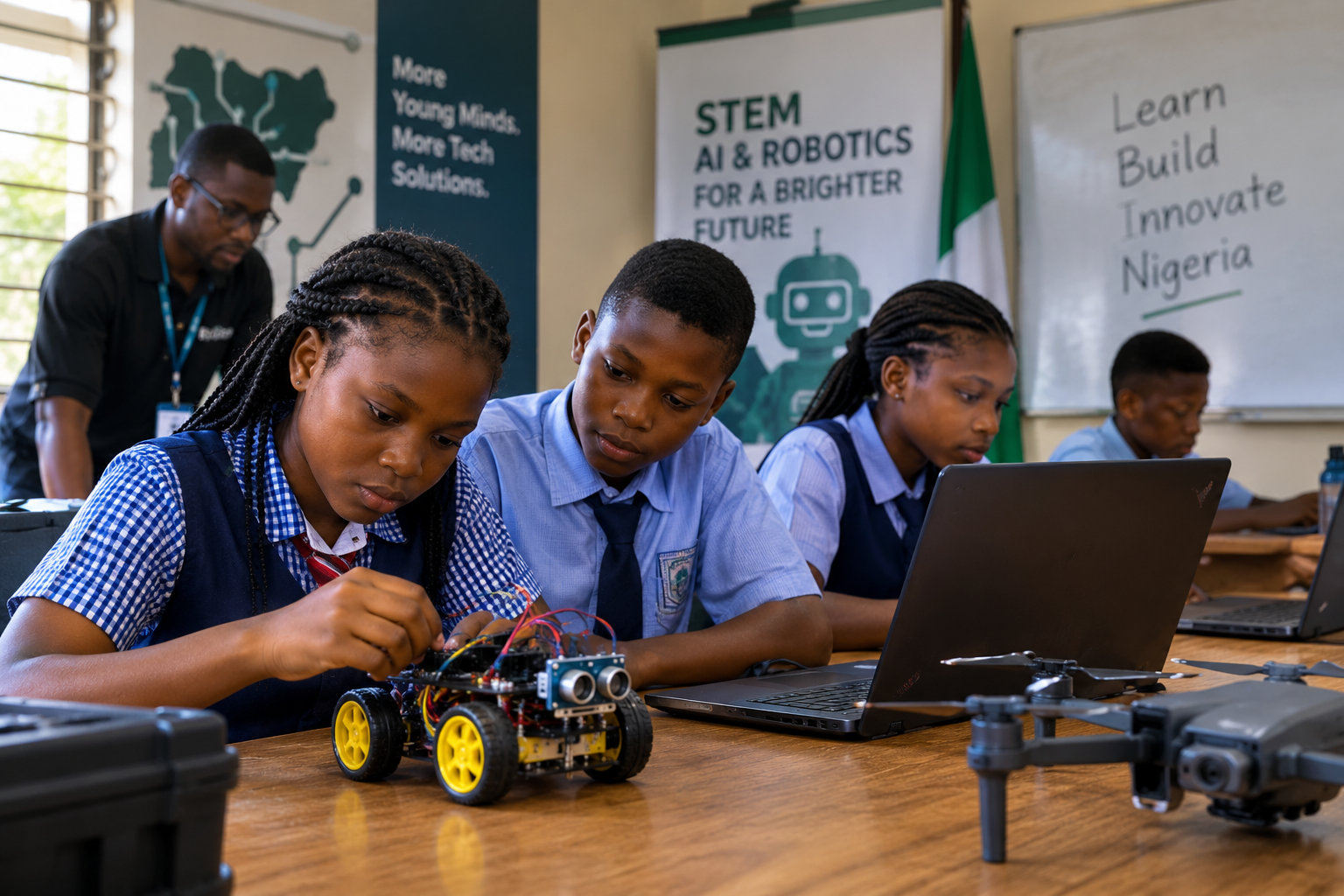
There is a simple reason for starting early: AI and robotics training in Nigeria can give the future technology workforce an earlier starting point. A student introduced to coding at 10 may have several years to practise before university.
A teenager who discovers robotics at 15 may eventually pursue engineering, computer science or another technical field. Another student introduced to AI could become interested in machine learning, data science or research.
Early exposure can therefore help children see technology as something they can build, rather than something they simply consume. That is particularly important for Nigeria, where the technology sector has become an increasingly important part of the country’s digital economy.
NITDA’s National Centre for Artificial Intelligence and Robotics (NCAIR) is already focused on areas including artificial intelligence, robotics, drones, machine learning, computer vision, data science and IoT. Its stated mission includes promoting research, development and adoption of AI, robotics and other Fourth Industrial Revolution technologies.
So the children’s programmes are not happening in isolation. They fit into a broader national push around emerging technologies.
But Learning AI Is Not the Same as Building Tech Talent
This is where the bigger challenge begins. A child can attend an AI or robotics programme, receive a certificate and leave excited about technology, but becoming genuinely skilled at AI or robotics takes much longer.
A short training programme can provide exposure. It cannot, on its own, provide years of practice, advanced mathematics, engineering knowledge, research experience or product-building skills.
The technology industry is no longer defined simply by knowing how to operate a computer or use basic software. Artificial intelligence, automation, robotics, drones, data science and other technologies are changing how industries solve problems and build products. All of these technologies also depend on the digital infrastructure that powers AI, cloud computing and modern internet services.
Nigeria does not only need more young people who know what artificial intelligence is. It needs people who can eventually build AI systems, develop robotics solutions, conduct research, create products and turn technology into businesses.
That requires continuity. Students need computers to practise with, they need reliable internet access, need teachers and mentors who can guide them, need laboratories and equipment for robotics and hardware projects, need mathematics and science foundations, need competitions, communities and practical projects that keep them engaged, and they need a clear pathway from basic exposure to advanced learning.
Without those things, a technology bootcamp can become an exciting experience that ends when the certificates are handed out.
What Happens After the Training Ends?
This may be the most important question Nigeria should ask about its technology education programmes. It is relatively easy to measure how many children attended a training programme.
It is much harder to measure what those children do two, five or ten years later.
Do they continue coding? Do they build another robot?
Do they have access to a computer at home or school? Do they find mentors?
Do they participate in technology competitions? Do they eventually study computer science, engineering, AI or related fields?
Do they create startups or contribute to research?
Those outcomes are what determine whether AI and robotics training in Nigeria becomes part of a genuine long-term talent pipeline. The certificate is not the destination. It should be the beginning.
A stronger pipeline would look something like this:
Early exposure → continued learning → mentorship → practical projects → advanced education → research or employment → entrepreneurship and innovation.
The real value of AI and robotics training in Nigeria will therefore depend on whether students have opportunities to continue learning after the initial programme.
Nigeria Is Building More Than One Entry Point Into AI
There are signs that Nigeria’s technology education strategy is beginning to stretch beyond short-term programmes. In August, NITDA welcomed the National Board for Technical Education’s introduction of a National Diploma curriculum in Artificial Intelligence for Nigerian polytechnics.
The agency described the curriculum as a step towards preparing young Nigerians for opportunities in the digital economy. The programme is also positioned within a wider technology landscape that includes cloud computing, cybersecurity, robotics, data science, IoT and intelligent automation.
That development is important because it creates a possible bridge between early exposure and more advanced education. AI and robotics training in Nigeria becomes more meaningful when that early exposure connects to formal education, internships and practical experience.
A student could encounter coding and robotics in primary or secondary school, develop an interest, and later pursue AI or another technology discipline at a technical institution.
That is much closer to a talent pipeline than a standalone bootcamp.
NCAIR also has an internship programme designed to help young Nigerians develop practical skills in AI, robotics and emerging technologies through guided learning, tasks and facilitator support.
The centre’s wider work includes AI research, technology commercialisation and efforts to connect research with startups, investors and industry.
The pieces are beginning to connect, but there is still a long way to go.
The Real Test Is Not How Many Children Are Trained
Nigeria should welcome programmes that introduce children to AI, robotics and other emerging technologies, but the success of AI and robotics training in Nigeria will ultimately depend on what students do after the programme ends.
The more meaningful question is what happens after the training. If a 12-year-old discovers robotics today, can that interest survive until university? If a secondary school student learns machine learning, can they access the resources needed to keep practising?
If students build a prototype, can they find mentors who will help them improve it? If a young person wants to become an AI researcher, is there a clear educational and career pathway?
Those questions are harder to answer. They also matter more, because Nigeria’s technology ambitions do not depend simply on producing digitally literate young people.
They depend on developing people who can solve difficult problems, build useful products, conduct research and compete in a global technology economy.
Conclusion
AI and robotics training in Nigeria gives children an important starting point, but that exposure must lead somewhere. NITDA’s recent programmes show that Nigeria is willing to introduce these skills earlier, while initiatives such as NCAIR and the new National Diploma AI curriculum suggest that the country is also building pathways beyond basic exposure.
But AI and robotics training in Nigeria alone will not create the next generation of Nigerian engineers, researchers, founders and technology leaders. For that to happen, the country needs to connect the different stages of the journey.
A child should not simply learn about AI once, they should have somewhere to go next.
That means better-equipped schools, trained teachers, reliable access to technology, mentorship, practical projects, advanced education, research opportunities and pathways into jobs or entrepreneurship.
The real impact of today’s programmes may therefore not be visible in 2026.
It could become visible years from now, when some of the children currently learning how to build robots, write code or experiment with AI become the people building Nigeria’s next technology companies, research institutions and products.
The training is the beginning. The real test is what Nigeria helps these students do next.