
Every search you make, every video you stream, every AI chatbot you use, and every photo you upload depends on one invisible technology: data centers.
While most people imagine “the cloud” as something floating somewhere on the internet, the reality is very different. The cloud lives inside enormous buildings filled with thousands or even millions of powerful servers working around the clock.
Among these facilities, the world’s largest data center stands out as an engineering marvel. It represents the backbone of modern digital infrastructure, enabling artificial intelligence, cloud computing, online banking, social media, healthcare systems, scientific research, and billions of internet connections every day.
As AI continues to reshape industries, these hyperscale facilities are becoming more important than ever. Companies like Microsoft, Google, Amazon, Meta, Oracle, and OpenAI are investing billions of dollars in expanding data center capacity to meet growing demand.
In this guide, you’ll discover how the world’s largest data centers work, the technology powering them, why they matter, and what the future holds for this rapidly evolving industry.
What Is the World’s Largest Data Center?
The world’s largest data center is a massive facility designed to store, process, and distribute enormous amounts of digital information.
Unlike traditional data centers built for a single company, modern hyperscale facilities support millions of users, thousands of businesses, and some of the world’s most demanding AI workloads.
The largest data center in the world is widely recognized as the China Telecom Inner Mongolia Information Park, located in Hohhot, Inner Mongolia. Covering more than 10 million square feet, it supports cloud services, artificial intelligence, big data analytics, and enterprise computing at an extraordinary scale.
However, “largest” can mean different things. Some rankings are based on building size, while others consider computing capacity, server count, power consumption, or total campus area.
That’s why companies such as Google, Microsoft, Amazon Web Services (AWS), Meta, and Oracle also operate some of the world’s most advanced hyperscale data center campuses.
Which Is the Largest Data Center in the World?
When measured by total floor space, the China Telecom Inner Mongolia Information Park consistently ranks among the largest data centers ever built.
Its enormous footprint allows it to host vast numbers of servers while supporting growing demand for AI, cloud computing, and internet services.
Several other facilities are also redefining what large-scale computing looks like:
- China Telecom Inner Mongolia Information Park – One of the world’s largest by floor area.
- Switch’s Citadel Campus (United States) – A massive hyperscale campus built for enterprise cloud services.
- Range International Information Hub (Indonesia) – One of Asia’s largest carrier-neutral data centers.
- Yotta NM1 (India) – One of the biggest hyperscale facilities in South Asia.
- Microsoft, Google, AWS, and Meta campuses – Although spread across multiple buildings, these collectively provide some of the greatest computing capacity on Earth.
Rather than competing only on size, today’s technology companies focus on efficiency, scalability, energy optimization, and AI performance.
How Data Centers Work
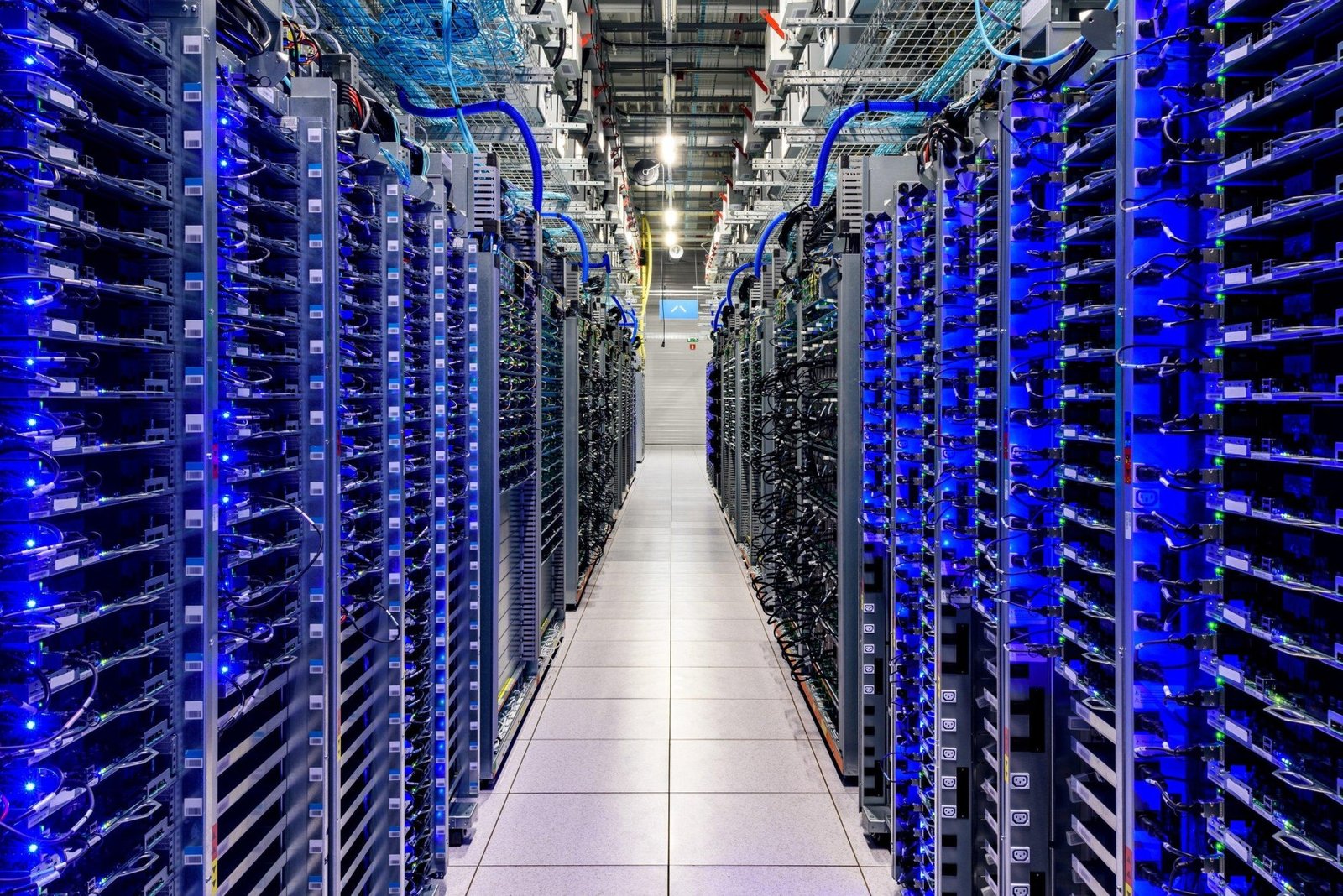
At first glance, a data center may look like endless rows of cabinets. Inside those cabinets is the technology that powers much of the modern internet.
Servers
Servers are specialized computers built to run continuously without interruption. They process search queries, store files, train AI models, stream videos, host websites, and perform millions of calculations every second.
A hyperscale data center may contain hundreds of thousands of servers working simultaneously.
Networking Infrastructure
Servers communicate through high-speed networking equipment, including routers, switches, and fiber-optic connections.
These networks move enormous amounts of data with minimal delay, ensuring websites, applications, and cloud services remain responsive.
Storage Systems
Every email, video, database, backup, and AI dataset needs reliable storage. Modern facilities combine solid-state drives (SSDs), hard disk arrays, and distributed storage systems to balance speed, capacity, and reliability.
Data is often replicated across multiple locations, reducing the risk of information loss if hardware fails.
RECOMMENDED: The Incredible Rise of Smart Glasses in 2026: Are They the Next Smartphone?
Backup Power Systems
Downtime can cost organizations millions of dollars.
That’s why data centers use several layers of backup power, including:
- Uninterruptible Power Supply (UPS) systems
- Large battery banks
- Diesel or natural gas generators
- Multiple utility power feeds
These systems keep operations running even during major power outages.
Internet Connectivity
A data center connects to multiple internet service providers through high-capacity fiber-optic cables. This redundancy ensures continuous access, even if one network experiences problems.
The Technology Behind the World’s Largest Data Center
Building the world’s largest data center involves far more than installing servers. It requires integrating advanced hardware, software, networking, cooling, and automation into one highly coordinated ecosystem.
AI Data Center Infrastructure
Artificial intelligence has dramatically changed data center design.
Instead of relying primarily on traditional CPUs, AI workloads increasingly depend on powerful GPUs and specialized AI accelerators capable of processing trillions of calculations quickly.
These systems enable:
- Large language models
- Image generation
- Scientific simulations
- Autonomous systems
- Real-time AI assistants
As AI adoption grows, demand for specialized AI data centers continues to rise.
Cloud Computing Infrastructure
Cloud computing allows businesses and individuals to access computing resources over the internet instead of maintaining physical servers.
The world’s largest data centers provide:
- Virtual machines
- Cloud storage
- Software-as-a-Service (SaaS)
- Platform-as-a-Service (PaaS)
- Infrastructure-as-a-Service (IaaS)
This flexibility enables organizations to scale resources in minutes rather than months.
High-Performance Networking
Data moves constantly between servers, storage systems, and users around the world. Modern hyperscale facilities rely on ultra-fast fiber networks and high-bandwidth switches to handle this traffic with minimal latency.
For AI training, networking speed is just as important as computing power because thousands of processors must communicate efficiently.
GPU Clusters
Training advanced AI models requires thousands of GPUs working together. These GPU clusters process vast datasets simultaneously, significantly reducing the time needed to train machine learning models.
As generative AI expands, GPU clusters have become one of the most valuable assets inside modern hyperscale data centers.
Automation and Robotics
Managing hundreds of thousands of servers manually is impractical. Automation systems continuously monitor hardware health, energy usage, cooling performance, and network traffic.
Some facilities also use robots to inspect equipment, replace failed components, and improve operational efficiency while reducing human error.
Why Hyperscale Data Centers Are Growing So Fast
Demand for digital services has never been higher. Every AI prompt, cloud backup, online purchase, video stream, and business application depends on powerful computing infrastructure running behind the scenes.
That’s why hyperscale data centers continue to expand across the world.
Artificial Intelligence Is Driving Unprecedented Growth
Generative AI has become one of the biggest forces behind new data center construction. Training and running large AI models requires enormous computing power, with thousands of GPUs operating simultaneously.
Technology companies are investing billions of dollars to build larger facilities capable of supporting next-generation AI applications.
Cloud Computing Continues to Expand
Businesses no longer want to maintain expensive on-site servers. Instead, they rely on cloud platforms to host websites, applications, databases, backups, and collaboration tools.
This shift has made cloud computing infrastructure one of the fastest-growing segments of the technology industry.
Streaming and Digital Content
Every movie streamed, song played, or live sporting event watched online passes through data centers before reaching your device.
With billions of users consuming digital content daily, providers need larger and more efficient server infrastructure than ever before.
Remote Work and Online Collaboration
Remote work has transformed how organizations operate.
Video conferencing, cloud document editing, virtual desktops, and collaboration platforms all depend on reliable data center technology to deliver seamless experiences.
Enterprise Digital Transformation
Organizations across healthcare, finance, manufacturing, education, and retail continue moving their operations online.
As more businesses adopt AI, automation, and cloud services, demand for scalable digital infrastructure will keep increasing.
Data Center Cooling Systems
One of the biggest challenges inside the world’s largest data center is managing heat.
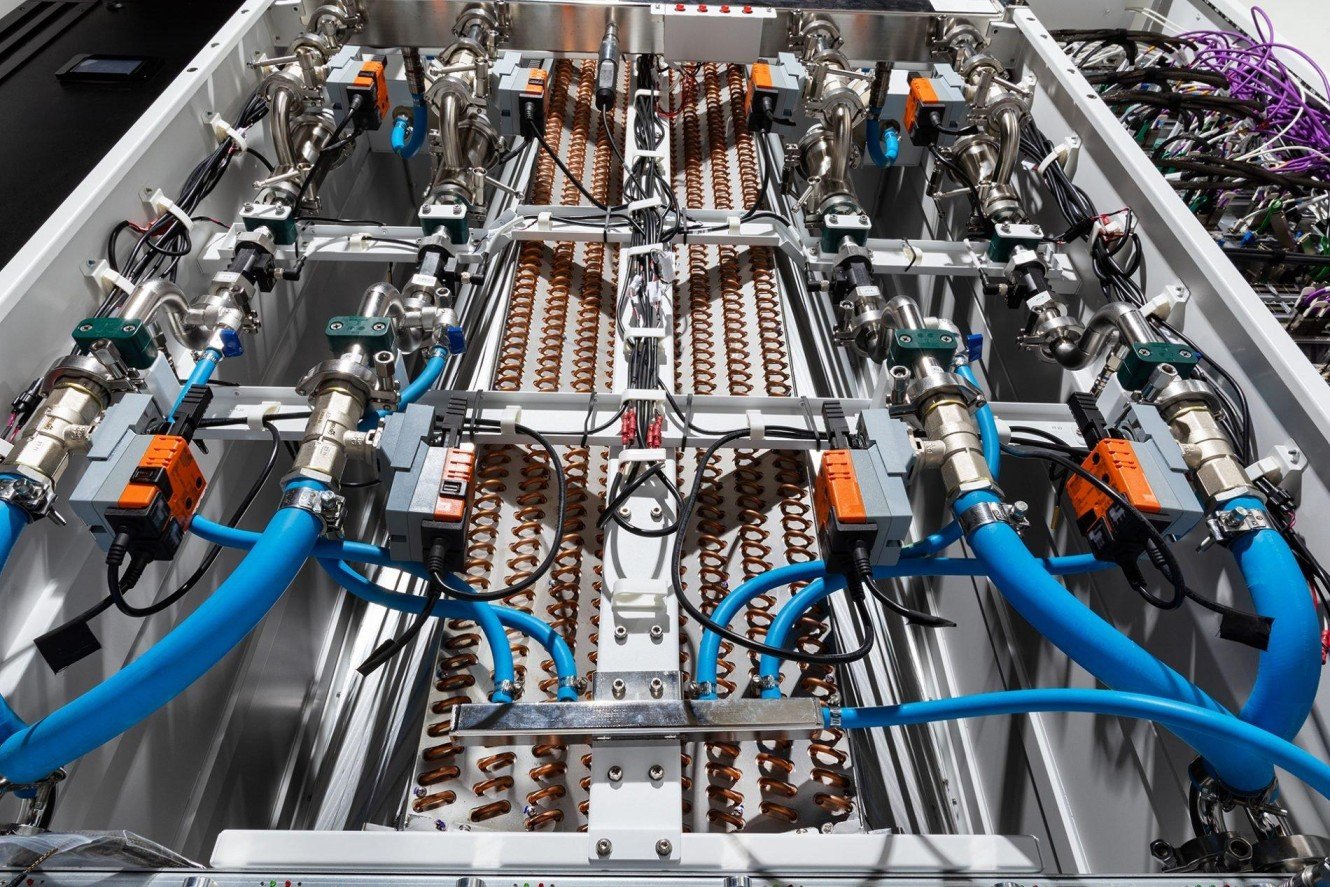
Thousands of servers running continuously generate enormous amounts of heat, and without effective cooling, equipment could fail within minutes.
Air Cooling
Traditional air cooling uses powerful fans and precision air-conditioning systems to circulate cool air through server racks while removing hot air.
Although still widely used, air cooling becomes less efficient as computing density increases.
Liquid Cooling
Modern AI servers consume far more power than conventional systems. Liquid cooling circulates coolant directly around processors, removing heat much faster than air.
RECOMMENDED: Top 10 Real Estate Companies in Enugu (2026): Best Property Developers for Land, Housing & Smart Investments
Many of today’s AI data centers are adopting this technology because it improves performance while reducing energy consumption.
Immersion Cooling
One of the newest innovations is immersion cooling. Instead of blowing air over hardware, servers are submerged in specially engineered, non-conductive liquids that absorb heat efficiently.
This approach lowers cooling costs, reduces noise, and supports increasingly powerful AI hardware.
Renewable Energy and Sustainability
Cooling accounts for a significant share of a data center’s energy use.
To reduce environmental impact, many operators now use:
- Free-air cooling in colder climates
- Recycled water systems
- Solar and wind energy
- AI-powered energy optimization
- Heat recovery systems
These innovations improve efficiency while helping reduce carbon emissions.
Security Inside the World’s Largest Data Centers
Data centers protect some of the world’s most valuable digital assets. Security is built into every layer of their design.
Physical Security
Access is tightly controlled through multiple security checkpoints.
Facilities often include:
- Biometric authentication
- Security guards
- CCTV surveillance
- Reinforced entrances
- Multi-factor access controls
Only authorized personnel can enter sensitive areas.
Cybersecurity
Physical protection alone isn’t enough. Advanced cybersecurity systems defend against malware, ransomware, distributed denial-of-service (DDoS) attacks, and unauthorized access.
Continuous monitoring helps identify and respond to threats in real time.
Disaster Recovery
Unexpected events such as fires, floods, earthquakes, or hardware failures can disrupt operations.
To minimize risk, critical data is replicated across multiple locations, allowing services to continue even if one facility experiences an outage.
Built-In Redundancy
Large data centers avoid single points of failure.
They duplicate critical systems, including:
- Power supplies
- Network connections
- Cooling equipment
- Storage systems
- Computing resources
If one component fails, another immediately takes over.
Environmental Impact and Sustainability
As data centers grow, so does their responsibility to operate sustainably. Large facilities consume substantial amounts of electricity, making energy efficiency a top priority.
Many leading technology companies have committed to powering their operations with renewable energy from solar, wind, and hydroelectric sources.
AI-powered energy management systems also help reduce waste by adjusting cooling, lighting, and power distribution based on real-time demand.
Water conservation is another major focus. Some operators now use recycled or non-potable water, while others rely on advanced cooling technologies that significantly reduce water consumption.
These innovations show that digital growth and environmental responsibility can go hand in hand.
The Future of Data Center Technology
The next generation of data centers will be built for an AI-first world. Future facilities will feature even denser GPU clusters, faster networking, and smarter automation to support increasingly complex workloads.
Edge computing will also play a larger role, placing smaller data centers closer to users to reduce latency for applications such as autonomous vehicles, smart cities, and real-time analytics.
Quantum computing, though still emerging, could eventually transform how certain scientific and industrial problems are solved, leading to specialized data center designs.
At the same time, modular construction, renewable energy integration, and intelligent resource management will make future facilities more scalable, resilient, and environmentally sustainable.
As technology evolves, the world’s largest data center will continue to push the boundaries of computing, powering innovations that shape how people work, communicate, and interact online.
Why the World’s Largest Data Centers Matter to Everyday Internet Users
It’s easy to think data centers only matter to technology companies. In reality, almost every digital service you use depends on them.
When you send a message, stream a movie, save photos to the cloud, shop online, or ask an AI assistant a question, your request is processed inside a data center before the response reaches your device.
Without these facilities, many everyday services would either slow down significantly or stop working altogether.
Some of the services powered by hyperscale data centers include:
- Search engines
- AI chatbots and virtual assistants
- Video streaming platforms
- Online banking
- Social media networks
- Cloud storage
- E-commerce websites
- Online gaming
- Healthcare systems
- Business collaboration tools
As internet usage continues to grow, the need for faster, more reliable, and more secure internet infrastructure will only increase.
The world’s largest data centers ensure that billions of people can stay connected every second of the day.
Conclusion
The world’s largest data center is far more than an enormous building filled with servers. It is the foundation of today’s digital world, enabling AI, cloud computing, online communication, streaming, financial services, scientific research, and countless other technologies people rely on daily.
As artificial intelligence continues to advance, hyperscale facilities will become even more powerful and sophisticated. Innovations in GPU computing, liquid cooling, renewable energy, automation, and security are already shaping the next generation of data center technology.
RECOMMENDED: AI in the Workplace: How AI Is Transforming the Modern Digital Workplace
Whether you’re using an AI assistant, watching a video, running a business in the cloud, or simply browsing the web, you’re benefiting from the incredible engineering behind these facilities. They are the invisible engines driving the internet—and their importance will only continue to grow in the years ahead.