
Blogging has changed dramatically over the last few years. What once took hours of research, writing, editing, designing, and promotion can now be done much faster with the right AI tools.
Whether you’re a beginner starting your first blog or an experienced publisher managing multiple websites, AI can help you work smarter without replacing your creativity.
The challenge isn’t finding AI tools. It’s finding the ones that are genuinely useful without paying for expensive subscriptions.
Many “free” AI tools are little more than limited trials. Others offer enough value to become an essential part of your blogging workflow before you ever consider upgrading.
READ MORE: Future of Mobile Money in Africa (2026): 10 Game-Changing Trends
After evaluating today’s most popular AI platforms based on usability, free-plan features, content quality, SEO capabilities, and productivity benefits, these are the best free AI tools every blogger should consider using in 2026.
The best free AI tools for bloggers in 2026 are ChatGPT, Claude, Google Gemini, Perplexity AI, Grammarly, Canva AI, Notion AI, Microsoft Copilot, Ahrefs AI Writing Tools, Google AI Studio, Leonardo AI, Ideogram, Pika, Buffer AI Assistant, and HubSpot AI. These tools help bloggers write faster, improve SEO, create images, edit content, automate social media, and grow their blogs without spending money.
If you’re searching for the best free AI tools for bloggers, this guide compares the top options available today and explains which ones are worth using for writing, SEO, design, research, and productivity.
Why the Best Free AI Tools for Bloggers Are More Important Than Ever
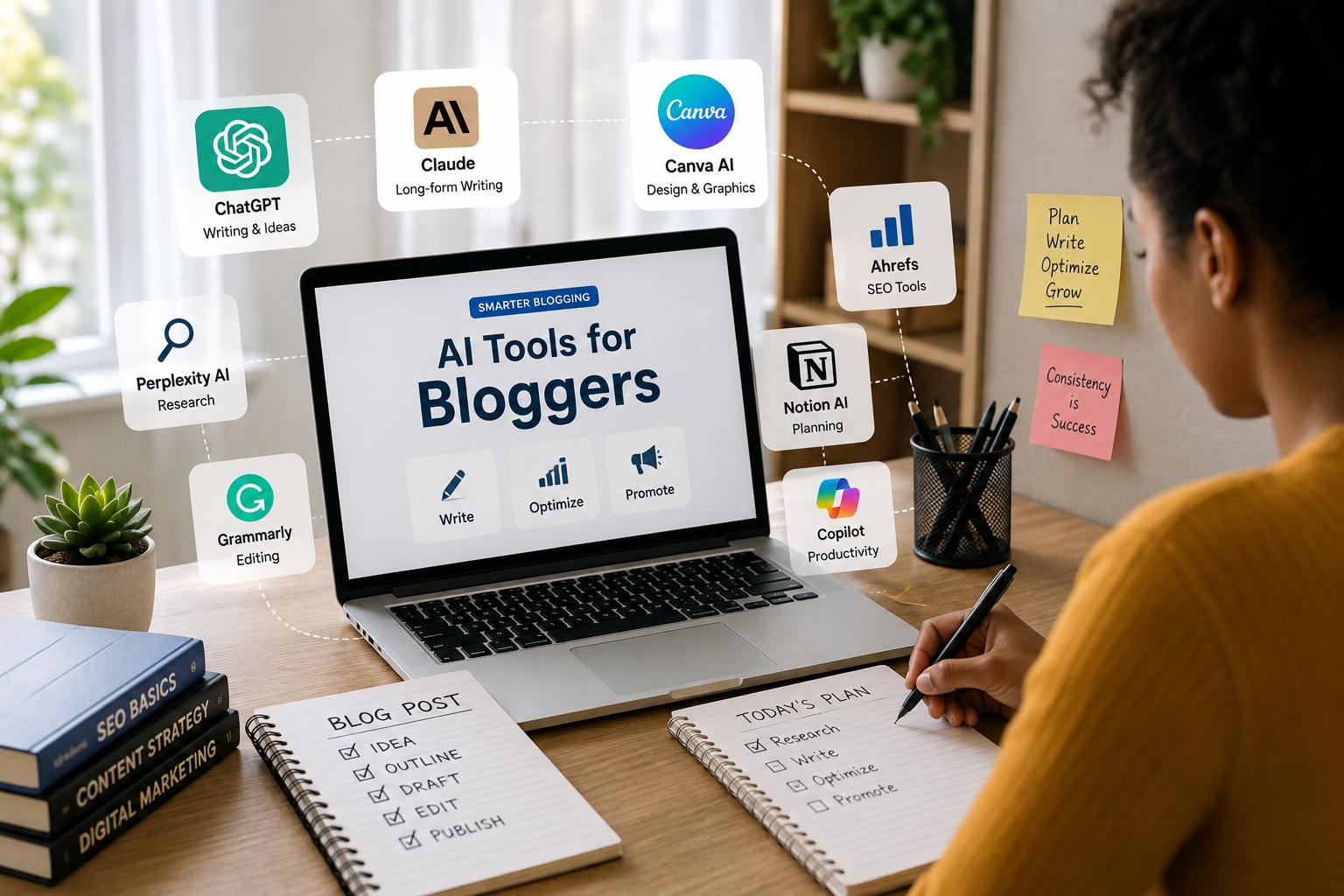
Successful blogging is no longer just about writing articles. A single post often requires keyword research, outlining, drafting, editing, image creation, SEO optimization, social media promotion, and performance analysis.
Doing all of this manually can quickly become overwhelming. That’s where AI makes a real difference.
Instead of replacing writers, today’s AI tools act like virtual assistants that help speed up repetitive tasks while allowing you to focus on producing original, valuable content.
Some of the biggest advantages include:
- Faster content research
- Better article outlines
- Improved grammar and readability
- SEO optimization suggestions
- AI-generated images
- Social media caption creation
- Content repurposing
- Brainstorming fresh blog ideas
When used responsibly, AI becomes a productivity tool rather than a shortcut.
Why You Can Trust This Guide
Choosing the right AI tool can save hours of work every week, but not every free tool delivers on its promises. This guide evaluates each tool based on the features that matter most to bloggers, including writing quality, SEO capabilities, ease of use, free plan limitations, productivity, and overall value.
READ MORE: 10 Common Email Scams to Watch Out for in 2026 (And How to Avoid Them)
Instead of recommending every popular AI platform, the focus is on tools that genuinely help bloggers create better content, streamline their workflow, and grow their websites efficiently.
This guide is designed to help you choose the best free AI tools for bloggers based on real blogging needs rather than marketing hype.
How We Chose the Best Free AI Tools
We compared dozens of platforms to identify the best free AI tools for bloggers, focusing on tools that offer real value without requiring an expensive subscription.
Not every AI platform deserves a place on this list. Each tool was evaluated using criteria that matter most to bloggers.
Free Plan Value
Some tools advertise free access but become unusable after only a few prompts. The tools below provide enough functionality to be genuinely useful without requiring immediate payment.
When evaluating the best free AI tools for bloggers, we gave priority to platforms that offer genuinely useful free features.
Ease of Use
A great AI tool should save time, not create more work. Simple interfaces and quick learning curves were prioritized.
Content Quality
Generating words isn’t enough. The tools selected produce content that serves as a strong starting point and can be refined into helpful, original articles.
SEO Capabilities
Modern blogging depends heavily on search visibility. Preference was given to tools that assist with keyword research, content optimization, search intent, and topical coverage.
Long-Term Value
The best free AI tools remain useful as your blog grows, making them worth integrating into your workflow.
Quick Comparison Table of the Best Free AI Tools
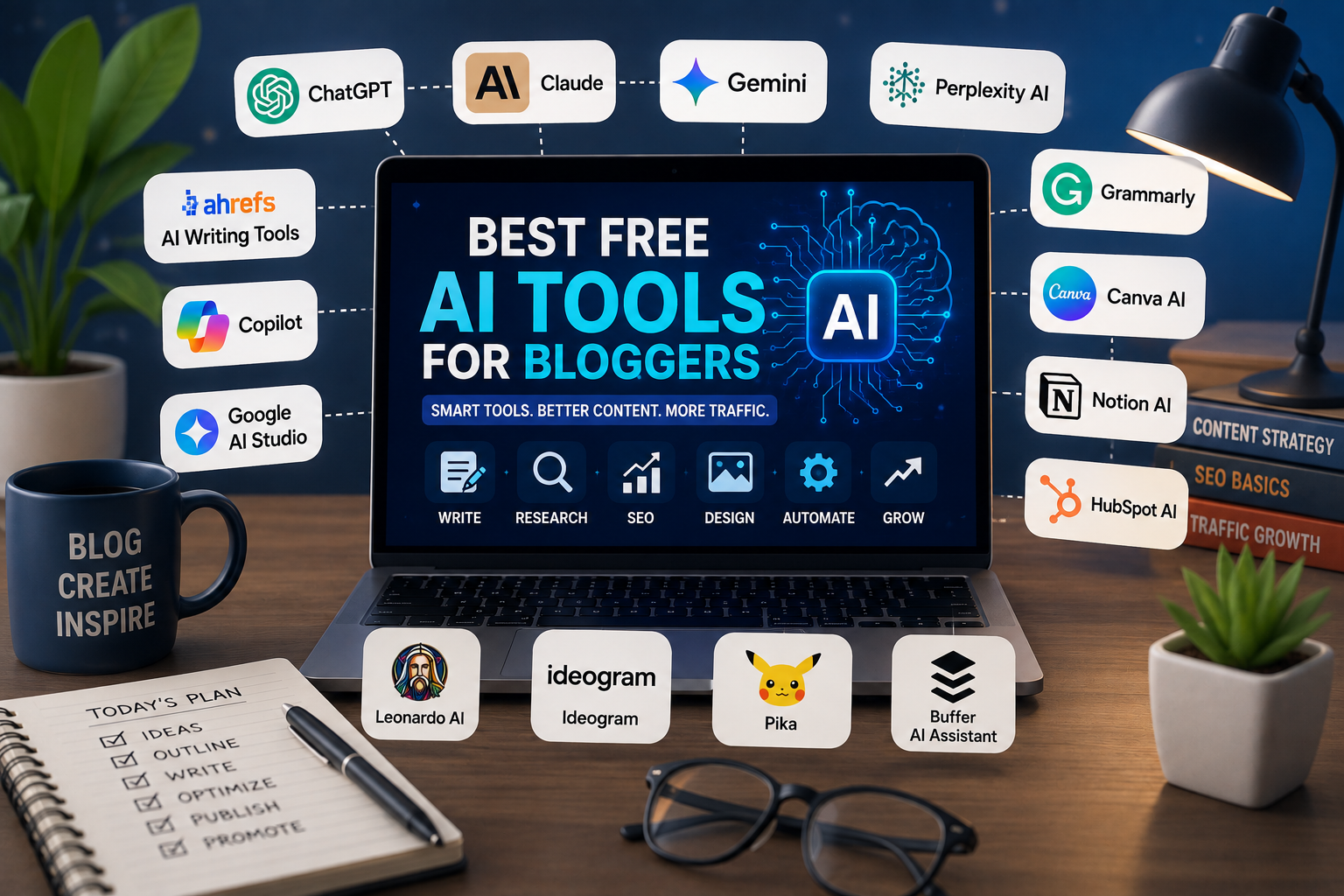
The comparison below gives you a quick overview of the best free AI tools for bloggers, making it easier to choose the right option based on your blogging needs.
| Tool | Best For | Free Plan | Ideal For |
|---|---|---|---|
| ChatGPT | Writing & brainstorming | Yes | All bloggers |
| Claude | Long-form writing | Yes | Guides & tutorials |
| Google Gemini | Research | Yes | Content planning |
| Perplexity AI | Fact checking | Yes | Research-heavy articles |
| Grammarly | Editing | Yes | Proofreading |
| Canva AI | Graphics | Yes | Featured images |
| Notion AI | Productivity | Limited | Content planning |
| Microsoft Copilot | Research & drafting | Yes | Microsoft users |
| Ahrefs AI Tools | SEO writing | Yes | SEO beginners |
| Google AI Studio | Advanced prompting | Yes | Technical bloggers |
| Leonardo AI | AI images | Yes | Visual content |
| Ideogram | Text-based graphics | Yes | Blog graphics |
| Pika | AI video creation | Yes | Short-form videos |
| Buffer AI Assistant | Social media | Yes | Content promotion |
| HubSpot AI | Marketing | Yes | Business bloggers |
If you’re short on time, this comparison table highlights the best free AI tools for bloggers at a glance.
15 Best Free AI Tools for Bloggers
After comparing features, usability, and free plan limitations, these are the best free AI tools for bloggers that consistently deliver value.
1. ChatGPT
If there’s one AI tool every blogger should know, it’s ChatGPT. From generating article ideas to creating detailed outlines and improving existing drafts, it handles almost every stage of content creation.
One of its biggest strengths is versatility.
You can use it to:
- Generate blog topics
- Create article outlines
- Rewrite paragraphs
- Improve readability
- Draft email newsletters
- Write social media captions
- Brainstorm headlines
- Create meta descriptions
- Generate schema ideas
- Build content calendars
Free Plan
The free version offers enough features for most bloggers getting started with AI.
Pros
- Beginner-friendly
- Excellent writing quality
- Supports multiple content formats
- Great for brainstorming
- Regular updates
Cons
- Requires human editing for originality
- Can occasionally produce outdated or inaccurate information if not verified
2. Claude.
Claude has become a favorite among bloggers who produce in-depth articles. Its writing style feels conversational, making it particularly useful for tutorials, opinion pieces, and educational content.
Claude also handles large amounts of text well, making it easier to edit lengthy drafts without losing context.
Free Plan
The free tier provides generous daily usage for most casual bloggers.
Pros
- Excellent long-form writing
- Natural tone
- Strong contextual understanding
- Great at rewriting content
Cons
- Usage limits during busy periods
- Fewer integrations than some competitors
3. Google Gemini
Gemini works especially well if your workflow revolves around Google Docs, Gmail, and Drive. It can summarize information, generate outlines, assist with writing, and help organize research faster.
Its integration with Google’s ecosystem makes it a practical option for bloggers who already rely on Google services.
Free Plan
A robust free version is available with access to core AI features.
Pros
- Seamless Google integration
- Fast responses
- Strong research capabilities
- Useful for planning content
Cons
- Writing style may require additional editing
- Some advanced features are reserved for paid users
4. Perplexity AI
One of the biggest challenges with AI-generated content is verifying information. Perplexity AI helps solve that by providing answers alongside cited sources, making it easier to confirm facts before publishing.
Instead of opening dozens of browser tabs, you can quickly gather insights, compare viewpoints, and discover authoritative references.
Free Plan
The free version offers generous daily searches and access to web-based research.
Pros
- Provides source citations
- Excellent for research
- Saves time gathering information
- Easy to use
Cons
- Not designed for complete article writing
- Advanced AI models have usage limits
5. Grammarly
Even experienced writers miss mistakes. Grammarly helps polish your articles by identifying grammar errors, awkward phrasing, punctuation issues, and readability improvements before you hit Publish.
It works across browsers, Microsoft Word, Google Docs, and many other writing platforms.
Free Plan
The free plan includes grammar, spelling, punctuation, and tone suggestions.
Pros
- Excellent proofreading
- Improves readability
- Easy browser extension
- Works almost everywhere
Cons
- Advanced writing suggestions require Premium
- Doesn’t replace careful editing
6. Canva AI
A great blog post deserves eye-catching visuals. Canva AI makes it simple to create featured images, Pinterest pins, YouTube thumbnails, banners, and social media graphics without advanced design skills.
Its AI-powered tools can generate images, remove backgrounds, expand photos, and even suggest layouts.
Free Plan
The free version includes thousands of templates and several AI-powered features.
Pros
- Beginner-friendly
- Huge template library
- Fast graphic creation
- Great for branding
Cons
- Some AI features require Canva Pro
- Premium templates are locked
7. Notion AI
Publishing consistently becomes much easier when your ideas are organized. Notion AI helps bloggers plan content calendars, summarize notes, draft outlines, manage editorial workflows, and keep projects organized in one place.
If you work with a team, collaboration is another major advantage.
Free Plan
The basic workspace is free, with limited AI usage included.
Pros
- Excellent organization
- Great for planning
- Clean interface
- Supports collaboration
Cons
- AI credits are limited
- Takes time to customize
While each platform has unique strengths, the best free AI tools for bloggers are the ones that fit naturally into your existing workflow.
8. Microsoft Copilot
Microsoft Copilot combines AI writing with web search, making it useful for drafting articles, researching topics, summarizing webpages, and brainstorming ideas.
It integrates well with Microsoft Edge and Microsoft 365 applications, making it particularly valuable if you already use those tools.
Free Plan
A capable free version is available for everyday writing tasks.
Pros
- Internet-connected responses
- Helpful research assistant
- Strong Microsoft integration
- Fast performance
Cons
- Some premium features require Microsoft 365
- Writing quality varies depending on prompts
9. Ahrefs AI Writing Tools
Ahrefs offers several free AI-powered writing and SEO tools that help bloggers create optimized titles, meta descriptions, introductions, outlines, and article ideas.
While they aren’t complete writing assistants, they’re extremely useful for improving search visibility.
Free Plan
Several AI writing tools are available at no cost through Ahrefs’ website.
Pros
- SEO-focused
- Easy to use
- Great for metadata
- Helpful for keyword optimization
Cons
- Limited compared to full AI assistants
- Requires other tools for complete article creation
10. Google AI Studio
Google AI Studio gives bloggers access to powerful Gemini models with more flexibility than many standard AI chat interfaces. It’s especially useful for creating custom prompts, testing content ideas, generating structured outputs, and experimenting with different writing styles.
Although beginners may find it slightly more technical, the additional control makes it worthwhile for experienced content creators.
Free Plan
A generous free tier is available for experimentation and everyday use.
Pros
- Powerful AI models
- Flexible prompting
- Fast responses
- Ideal for advanced users
Cons
- Interface has a learning curve
- Better suited to experienced users
11. Leonardo AI
Stock photos can make your content look generic. Leonardo AI allows bloggers to create unique illustrations, featured images, concept art, product mockups, and custom visuals that better match their brand.
Its prompt controls also make it easier to generate consistent styles across multiple blog posts.
Free Plan
Daily free tokens allow users to generate several images each day.
Pros
- High-quality image generation
- Multiple artistic styles
- Fast rendering
- Commercial-friendly output
Cons
- Daily token limits
- Requires prompt experimentation
12. Ideogram
Many AI image generators struggle with text inside images. Ideogram stands out by producing logos, quote graphics, blog banners, and promotional images with much more accurate typography.
That makes it especially useful for featured images and social media graphics.
Free Plan
Includes daily image generation with access to core features.
Pros
- Excellent text rendering
- High-quality graphics
- Easy prompt system
- Great for branding
Cons
- Limited daily generations
- Premium features require a subscription
13. Pika
Writing a great blog post is only half the job. Promoting it across platforms like YouTube Shorts, TikTok, Instagram Reels, and Facebook can significantly increase your traffic. Pika helps turn ideas, images, or text prompts into short AI-generated videos without requiring professional editing skills.
This makes it easier to repurpose your blog content into engaging video clips that attract a wider audience.
Free Plan
The free plan includes limited monthly video generations, making it suitable for bloggers who publish occasionally.
Pros
- Easy-to-use interface
- Fast video generation
- Ideal for short-form content
- No advanced editing experience required
Cons
- Watermarks and generation limits on the free plan
- Complex videos may require multiple edits
14. Buffer AI Assistant
Publishing a blog post is just the beginning. Buffer AI Assistant helps generate social media captions, repurpose blog content into multiple posts, and maintain a consistent posting schedule across platforms.
Instead of writing separate captions for every network, you can quickly generate platform-specific variations that save time while keeping your messaging consistent.
Free Plan
The free plan supports a limited number of social accounts and scheduled posts, making it ideal for individual bloggers.
Pros
- Generates engaging captions
- Helps maintain posting consistency
- Supports multiple social platforms
- Simple scheduling interface
Cons
- Limited scheduling on the free plan
- Advanced analytics require a paid subscription
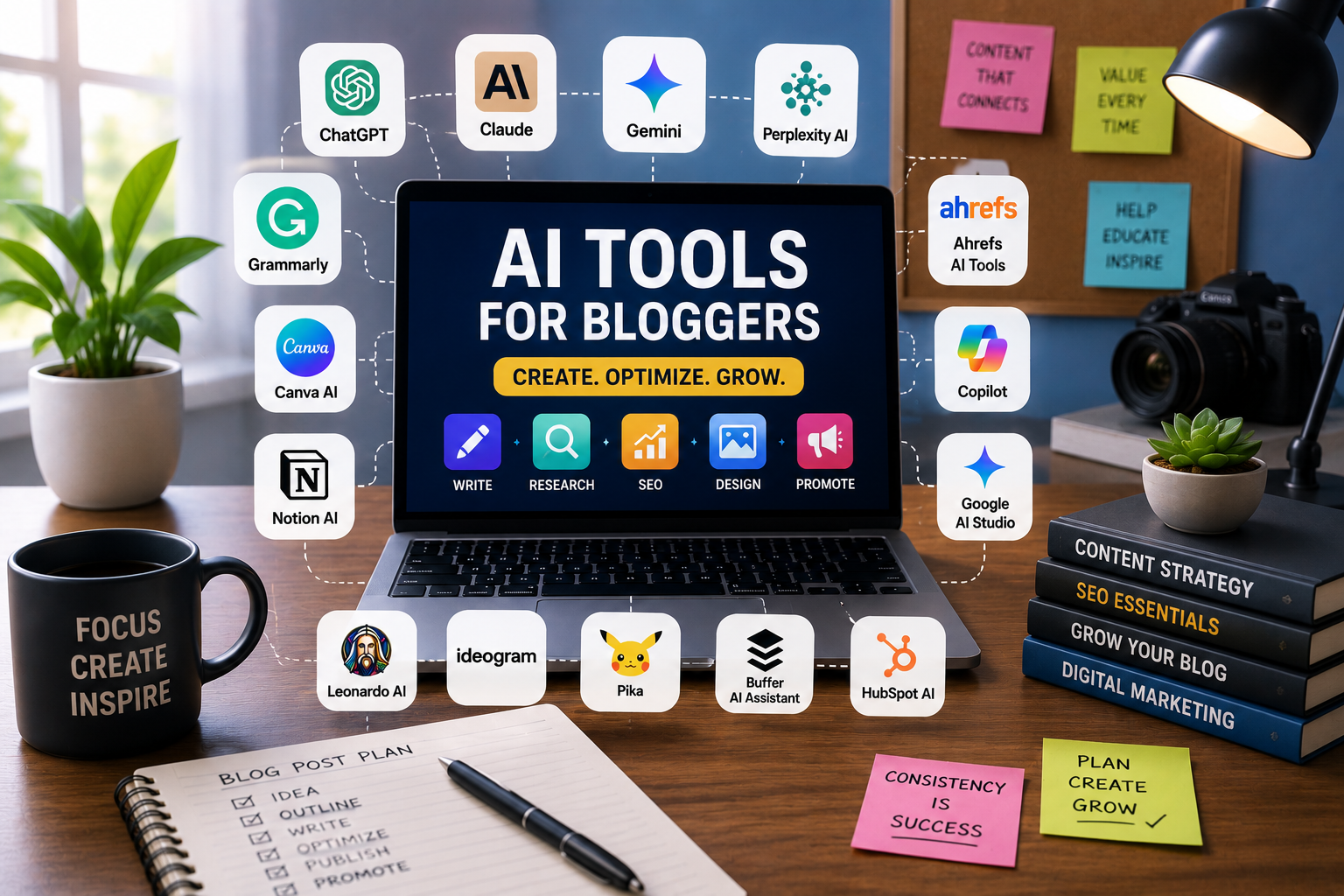
15. HubSpot AI
Growing a successful blog isn’t just about attracting visitors,, it’s about keeping them. HubSpot AI helps bloggers write marketing emails, landing pages, calls-to-action, newsletters, and promotional content that encourages readers to return.
If you’re building an email list or selling products and services through your blog, this tool can streamline your marketing workflow.
Free Plan
HubSpot offers free CRM and marketing tools with access to selected AI-powered features.
Pros
- Excellent marketing tools
- Built-in CRM
- Helpful email writing assistance
- Great for lead generation
Cons
- Some advanced AI features require paid plans
- Better suited to growing blogs and businesses
Which Free AI Tool Is Best for Different Types of Bloggers?
Choosing from the best free AI tools for bloggers depends on your goals, budget, and the type of content you create.
Not every blogger has the same needs. If you’re just starting, you’ll likely benefit most from an all-purpose AI assistant. As your blog grows, you’ll probably combine several specialized tools.
Here’s a quick recommendation based on different blogging goals:
| Blogging Goal | Recommended Tool |
|---|---|
| Writing blog posts | ChatGPT |
| Long-form content | Claude |
| Research and fact-checking | Perplexity AI |
| Keyword research and SEO | Ahrefs AI Writing Tools |
| Grammar and editing | Grammarly |
| Featured images | Canva AI |
| AI-generated illustrations | Leonardo AI |
| Content planning | Notion AI |
| Video marketing | Pika |
| Social media promotion | Buffer AI Assistant |
| Email marketing | HubSpot AI |
Using a combination of these tools often delivers better results than relying on just one.
Can AI Help You Rank Higher on Google?
AI alone won’t improve your rankings. Search engines reward content that is accurate, original, helpful, and written to satisfy search intent. Google recommends creating helpful, people-first content that demonstrates experience, expertise, authoritativeness, and trustworthiness.
The best free AI tools for bloggers can speed up research, improve content quality, and streamline your workflow, but they can’t replace your expertise or experience.
To use AI effectively:
- Verify facts before publishing.
- Add personal insights and real-world examples.
- Edit AI-generated content thoroughly.
- Optimize for search intent, not just keywords.
- Include original images, screenshots, or examples where possible.
- Keep your content updated regularly.
Think of AI as a co-writer, not an autopilot. Even the best free AI tools for bloggers won’t deliver results if they’re used without editing, fact-checking, and a clear content strategy.
Common Mistakes Bloggers Make When Using AI
Many bloggers fail to get results because they rely too heavily on automation.
Avoid these common mistakes:
- Publishing AI-generated content without editing.
- Ignoring keyword research.
- Stuffing articles with keywords.
- Copying AI output word for word.
- Skipping fact-checking.
- Forgetting internal and external links.
- Neglecting user experience and readability.
- Publishing thin or repetitive content.
The bloggers who succeed with AI are those who combine technology with human creativity and expertise.
Conclusion
After reviewing the best free AI tools for bloggers, it’s clear that no single platform does everything perfectly. For most bloggers, a combination of tools delivers the best workflow.
A practical setup could look like this:
- ChatGPT for brainstorming, outlining, and drafting.
- Perplexity AI for research and verifying information.
- Grammarly for editing and polishing.
- Canva AI or Leonardo AI for creating visuals.
- Ahrefs AI Writing Tools for improving SEO.
- Buffer AI Assistant for promoting your content across social media.
Most importantly, don’t feel pressured to use every tool on this list. Start with the ones that solve your biggest challenges today, then expand your toolkit as your blog grows.
AI is no longer a luxury for bloggers, it’s a practical way to work more efficiently while maintaining quality. The best free AI tools for bloggers can help you research topics, write engaging articles, improve SEO, design professional graphics, create promotional videos, and market your content without stretching your budget.
READ MORE: How to Protect Your Privacy Online (2026): 15 Proven Tips to Stay Safe
The most effective approach is to choose tools that solve your biggest challenges rather than trying to use everything available. As your blog grows, you can expand your toolkit while continuing to focus on creating original, helpful, and trustworthy content that serves your readers.
Whether you’re launching your first blog or scaling an established website, these free AI tools provide an excellent starting point for building a faster, smarter, and more productive blogging workflow.
By choosing the best free AI tools for bloggers that match your workflow, you’ll save time, publish better content, and grow your blog more efficiently in 2026 and beyond.