
Nigeria fibre cuts are becoming a growing problem as businesses, financial services, government platforms, and consumers become more dependent on telecommunications, but the infrastructure carrying that activity is facing a growing problem: fibre-optic cables are being damaged across the country at a rate that is becoming difficult to ignore.
The Nigerian Communications Commission (NCC) said more than 5,000 fibre-cut incidents were recorded in the first six months of 2026, with road construction, excavation, and related civil works among the major causes.
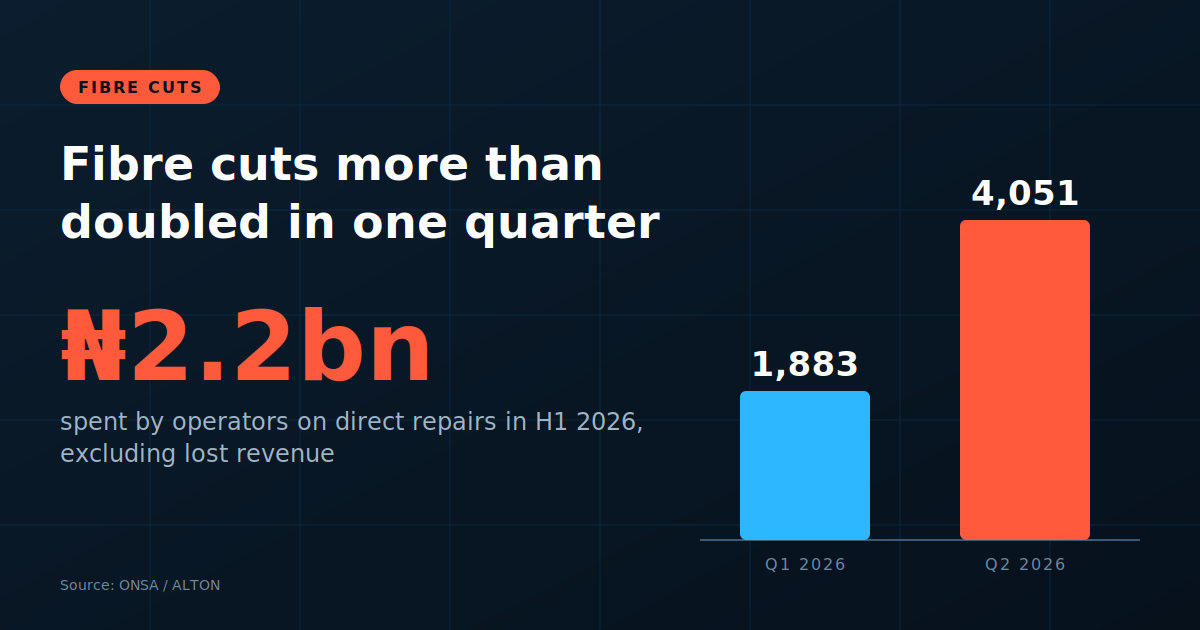
A more recent report citing the Office of the National Security Adviser put the number at 5,934 fibre-optic cuts between January and June, with incidents increasing from 1,883 in the first quarter to 4,051 in the second quarter. Operators reportedly spent about ₦2.2 billion on direct repairs during the period, excluding lost revenue and money diverted from network expansion.
The problem is becoming more serious because Nigeria’s economy is increasingly relying on the networks being damaged.
Nigeria Is Becoming More Dependent on Telecoms
The numbers show how important telecommunications have become to Nigeria’s economy.
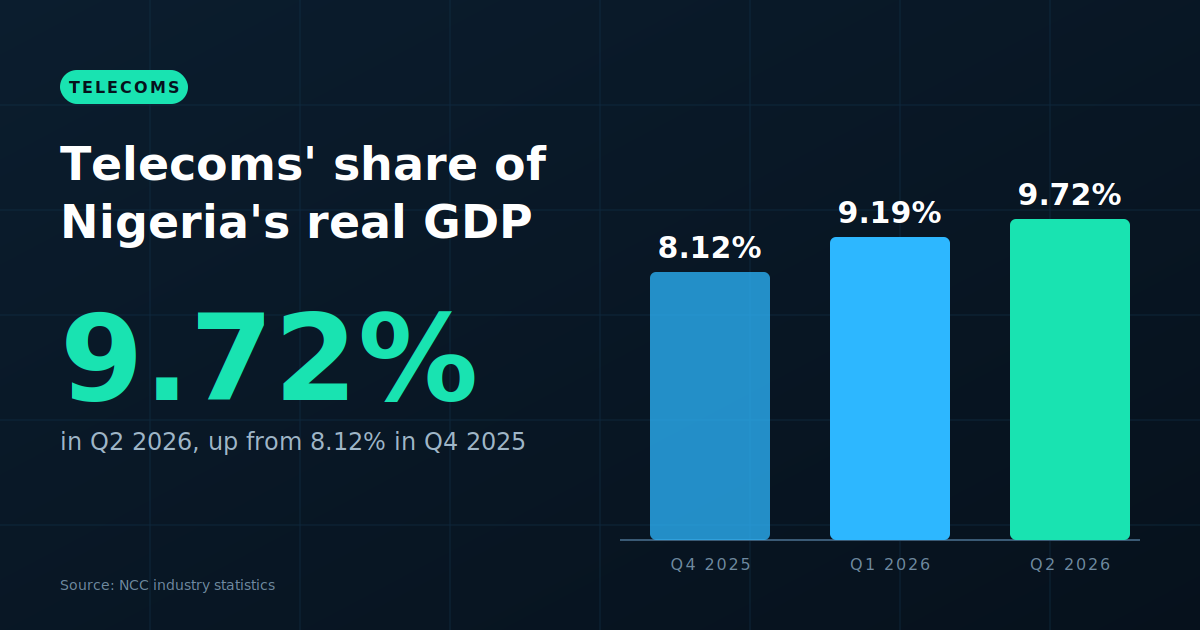
According to the NCC’s latest industry statistics, telecommunications contributed 9.72% of Nigeria’s real GDP in the second quarter of 2026. That was up from 9.19% in the first quarter and 8.12% in the fourth quarter of 2025.
That does not mean telecoms directly account for almost one-tenth of every economic activity in the country. Rather, it shows the size of the telecommunications industry’s direct contribution under Nigeria’s GDP measurement.
Its wider importance is even harder to isolate because telecom networks now sit underneath many other sectors.
Banks need connectivity to process transactions. Fintech companies need networks to serve customers. Businesses depend on internet access for communication, cloud applications, and online sales. POS terminals need connectivity to complete payments, while government agencies increasingly rely on digital platforms.
Nigeria’s growing mobile market is adding to that dependence. Nigeria’s mobile subscriber base is growing again, with active mobile subscriptions reaching 195.1 million in July 2026, according to NCC data. More Nigerians are using mobile networks for internet access, payments, business, education, and other services.
The result is a simple shift: a network problem that once affected mainly phone calls or internet browsing can now interrupt economic activity. Nigeria fibre cuts are becoming more significant because the networks they damage now support far more than basic communication.
How Nigeria Fibre Cuts Are Getting Worse
Nigeria fibre cuts are becoming more than a telecommunications story because the infrastructure supports banking, government services, businesses, and other parts of the economy.
The NCC has described communications infrastructure as a critical national lifeline supporting banking, government services, education, healthcare, commerce, security, and emergency communications.
The Office of the National Security Adviser has similarly warned that damage to fibre infrastructure affects economic productivity and public services, rather than simply causing a temporary telecom outage.
The latest H1 figure cited by ONSA shows that fibre incidents increased sharply during the first half of 2026, from 1,883 in Q1 to 4,051 in Q2. That means the problem was not simply continuing at the same level; it became more severe as the year progressed.
The causes are varied.
The NCC’s fibre reporting system tracks incidents involving construction, degradation, vandalism or sabotage, bush burning, core breaks, force majeure and other causes, but road construction has become a particularly important part of the conversation.
In August, the NCC said more than 5,000 fibre-cut incidents in the first half of the year were linked to road construction, excavation, and related civil works. The Nigerian Communications Commission also called for stronger coordination between road construction and telecom infrastructure.
A Fibre Cut Is No Longer Just a Telecom Problem
For an ordinary internet user, Nigeria fibre cuts may look like a slow connection, a failed call, or an internet outage. For a business, the consequences can be much wider.
A failed connection can prevent a POS terminal from completing a payment. It can interrupt communication between employees and customers. It can make cloud-based software unavailable. It can disrupt logistics systems or prevent customers from accessing digital services.
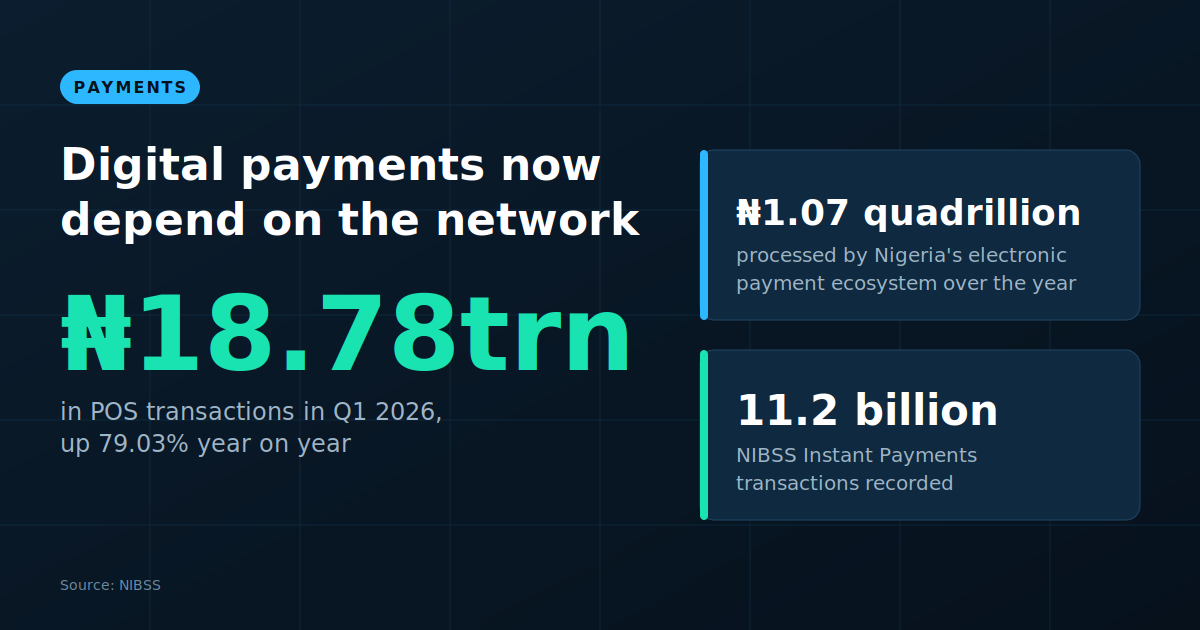
The same infrastructure also supports financial services. NIBSS reported that the value of POS transactions reached ₦18.78 trillion in the first quarter of 2026, up 79.03% from the same period a year earlier. The payment infrastructure body’s published figures show how heavily Nigeria’s economy is relying on digital transactions.
Separately, NIBSS reported that Nigeria’s electronic payment ecosystem processed about ₦1.07 quadrillion in transactions over the preceding year, with NIBSS Instant Payments recording 11.2 billion transactions.
These figures help explain why network reliability has become an economic issue. When digital payments become part of everyday commerce, connectivity becomes part of the infrastructure of commerce itself.
Why Road Construction Has Become Part of the Problem
Nigeria has another infrastructure challenge that makes the fibre problem harder to solve: roads and telecommunications networks often occupy the same corridors.
Fibre cables need to reach communities, businesses, and network sites. Roads provide some of the most practical routes for deploying and maintaining that infrastructure, but the same road corridors are also being excavated, widened, repaired, and rebuilt.
Without accurate mapping and coordination, construction work can cause Nigeria fibre cuts by damaging cables buried underground.
The NCC says the government has established a Standing Committee involving communications and works authorities and security stakeholders to develop better coordination mechanisms.
Recent reporting also says the NCC is developing a centralized underground infrastructure mapping database, alongside a framework for pre-excavation notification and penalties for damage to marked infrastructure. Those measures, however, are not yet fully enforceable.
That distinction matters. Nigeria does not necessarily have to choose between building roads and expanding digital infrastructure. The challenge is making both systems work together.
Nigeria Is Building More Fibre But Can It Protect It?
The timing makes the issue even more important.
Nigeria is planning one of its largest broadband infrastructure expansions through the Building Resilient Digital Infrastructure for Growth (BRIDGE) project.
The World Bank says the BRIDGE project will deploy more than 90,000 kilometres of fibre, taking the country’s national fibre backbone from about 35,000 kilometres to 125,000 kilometres. The project is designed to expand high-speed broadband into underserved and unserved parts of the country. The project is designed to expand high-speed broadband into underserved and unserved parts of the country.
That expansion could significantly improve Nigeria’s connectivity, but it also creates a bigger protection challenge.
If fibre continues to be damaged during construction, vandalism, or other activities, adding tens of thousands of kilometers of new cable will not automatically produce more reliable networks.
The country therefore needs to think about two things at the same time: how much infrastructure it has and how well it can protect that infrastructure.
That becomes particularly important as Nigeria expands cloud computing, fintech, e-commerce, digital government services, and other parts of the digital economy. Nigeria’s broader $1 trillion economic ambition also depends on the growth of digital infrastructure and technology.
What the Government Is Doing
The NCC has been pushing for stronger protection of telecom infrastructure, while the Federal Ministry of Works and other agencies are being brought into the process.
The regulator has called for better coordination between road contractors, engineers, government agencies, and telecommunications operators before excavation begins.
The government has also designated telecommunications infrastructure as part of Nigeria’s Critical National Information Infrastructure framework, giving the infrastructure additional legal protection.
The NCC has set a target of reducing fibre-cut incidents by 40% before the end of 2026, according to recent reporting.
Whether that target is achieved will depend on how quickly mapping, coordination, enforcement, and infrastructure-protection measures move from policy discussions into routine practice.
What Fibre Cuts Mean for Nigerians and Businesses
For consumers, frequent fibre damage can show up as poor network quality, interrupted internet access, failed transactions, and unreliable digital services.
For businesses, repeated outages can become an operating cost.
Companies may have to switch connectivity providers, maintain backup connections, or absorb downtime when network infrastructure fails.
Telecom operators also face direct repair costs. The Association of Licensed Telecommunications Operators of Nigeria said operators spent about ₦2.2 billion on direct fibre-cut repairs in the first half of 2026, excluding revenue losses and capital that could otherwise have gone toward network expansion.
That creates a difficult cycle. Operators invest in expanding networks.
The networks support more economic activity, but repeated damage means some resources have to be redirected toward repairing infrastructure that has already been deployed.
That does not mean fibre cuts are the only problem facing Nigeria’s telecom industry. Power costs, right-of-way issues, equipment security, network congestion, and other infrastructure challenges also affect service quality.
But the frequency of physical fibre damage makes it an increasingly visible part of the reliability problem.
Conclusion
Nigeria’s digital economy is still expanding, and the country is preparing to deploy substantially more fibre.
That makes infrastructure protection a long-term issue rather than a temporary response to a few network outages.
The next stage will require better coordination between road projects and telecom deployments, more accurate mapping of underground infrastructure, stronger enforcement, and faster communication before excavation begins.
It will also require network resilience. Alternative routes and redundancy can reduce the impact when individual fibre links are damaged, but resilience costs money. The more reliable Nigeria wants its digital economy to become, the more important those investments will be.
The bigger lesson is that digital infrastructure cannot be treated as something separate from the physical economy.
Nigeria can build more roads, deploy more fibre, expand mobile networks, and connect more businesses. But if the infrastructure connecting those systems remains vulnerable to repeated damage, the country’s digital growth will continue to face a very physical problem.
Read more on technology and digital trends on NaysBlog.