
Nigeria fintech industry is entering a new phase, moving beyond digital payments toward the infrastructure needed to support a broader digital economy. After years of making digital payments easier and more accessible, the sector is now turning its attention to the infrastructure needed to support a much larger digital economy.
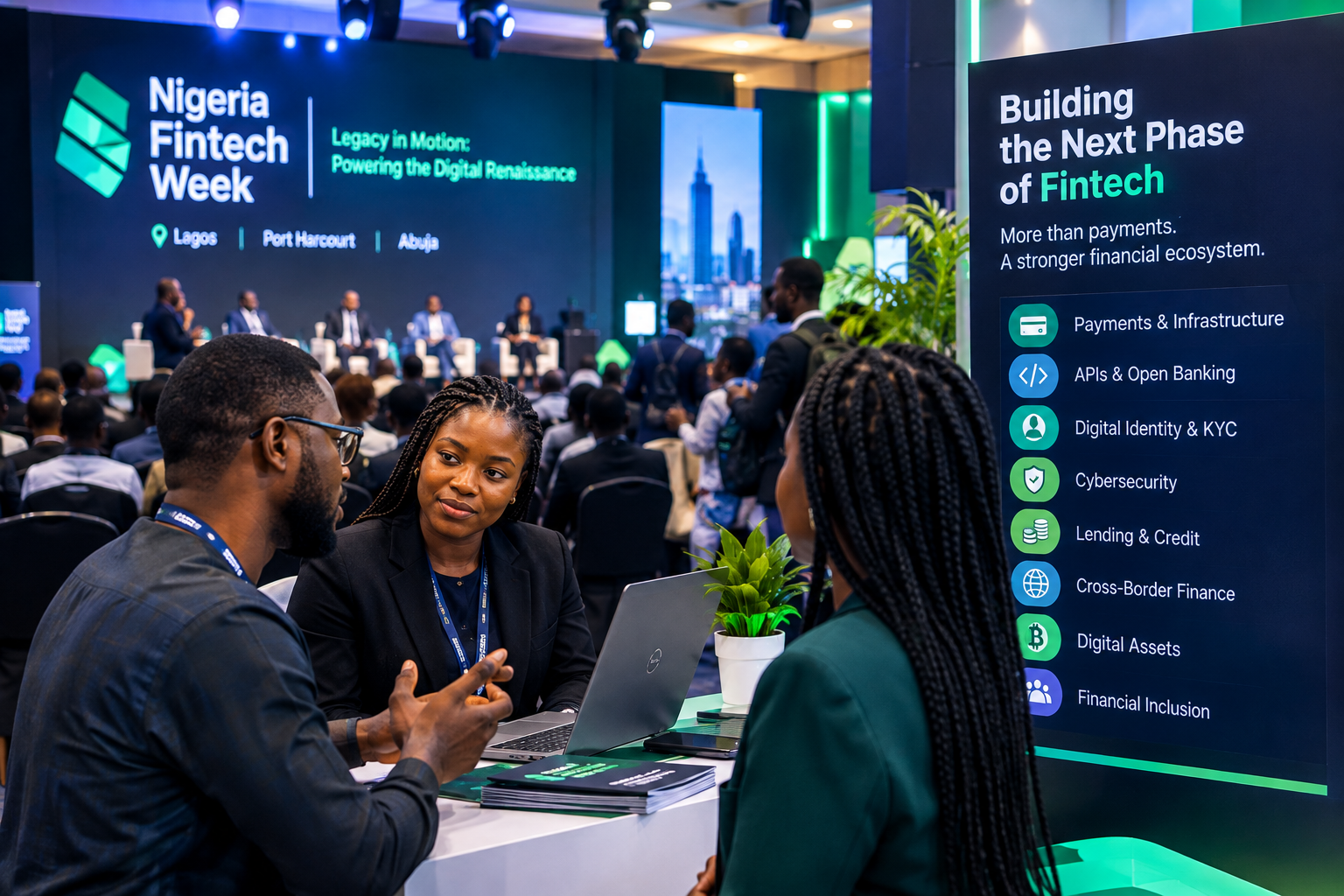
The shift comes as Nigeria Fintech Week begins on September 22, with banks, fintech companies, investors, and regulators meeting across Lagos, Port Harcourt, and Abuja. Its 2026 program covers payments and infrastructure, regulation, cross-border finance, lending, digital assets, embedded finance, banking transformation, and financial inclusion.
The timing is notable because the industry has just seen what happens when demand for digital financial services rises faster than the systems supporting them.
Last week, the Dangote Petroleum Refinery IPO overwhelmed several Nigerian digital investment platforms as retail investors rushed to participate. Reuters reported that Bamboo experienced a tenfold traffic increase within 30 minutes, while Bamboo, Cowrywise, and InvestNaija experienced outages.
The episode points to a bigger question for Nigeria’s fintech industry: can the infrastructure behind digital finance keep up as more Nigerians use these services?
Nigeria’s Fintech Industry Has Outgrown the Payments-Only Story

Digital payments remain at the heart of Nigeria’s fintech ecosystem. Over the past decade, fintech companies have made it easier for Nigerians to transfer money, pay bills, receive payments, manage wallets, and access financial services from their phones.
But the industry is no longer focused only on getting people to use digital payments.
In a September 20 report, Punch quoted FintechNGR Vice President and Nigeria Fintech Week Chairman Jameelah Sharrieff-Ayedun as saying the sector had moved from proving that digital payments could work toward building the core financial infrastructure of a modern economy.
That is a significant change in the industry’s focus. The next stage is less about individual payment apps and more about the systems that allow banks, fintechs, businesses, and consumers to interact reliably.
That includes payment rails, APIs, digital identity, credit infrastructure, cybersecurity, compliance systems, and the technology required to process increasingly large volumes of financial activity.
In other words, fintech is becoming part of the infrastructure of the digital economy itself.
Why Is the Nigeria Fintech Industry Changing?
The Nigeria fintech industry has become more complex as companies have expanded into more areas of financial services. Payments are now connected to lending, investment, banking, insurance, savings, and cross-border transactions.
That creates new infrastructure requirements. A fintech platform needs to be able to handle sudden increases in users and transactions. It may also need to connect with banks, payment processors, identity systems, and other technology providers.
At the same time, regulators are introducing rules around areas such as open banking, digital assets, KYC, and licensing.
Nigeria Fintech Week’s 2026 agenda reflects this broader ecosystem. Its nine tracks cover payments and infrastructure; regulation and compliance; cross-border and African expansion; lending, credit, and capital markets; digital assets; embedded finance and APIs; banking transformation; and wealthtech, insurtech, and financial inclusion.
The important point is that payments have not disappeared from the industry’s priorities. They have become one part of a much bigger financial technology stack. MTN MoMo’s expansion beyond traditional mobile money is one example of how this broader digital-finance market is developing.
The Dangote IPO Exposed a Fintech Infrastructure Problem
The recent Dangote Petroleum Refinery IPO provides a useful example of why this infrastructure matters. The IPO attracted significant interest from retail investors, many of whom relied on digital investment platforms to participate.
The sudden increase in demand put some of those platforms under pressure. Reuters reported that Bamboo’s traffic increased tenfold within 30 minutes. The surge affected Bamboo’s systems as well as some of its third-party providers. Cowrywise and InvestNaija also experienced outages during the rush.
The lesson is bigger than the IPO itself. A digital financial platform can work normally under ordinary conditions and still struggle when demand suddenly increases.
That is where infrastructure becomes critical. If thousands of customers try to buy shares, transfer money, or access an account at the same time, the application is only one part of the system. The networks, payment providers, databases, APIs, and other services supporting it also have to cope with the demand.
For the Nigeria fintech industry, that means scaling is no longer just about acquiring more customers. It is also about being able to serve those customers reliably when they arrive.
What Does Fintech Infrastructure Actually Mean?
Fintech infrastructure is the technology, systems, and networks that allow digital financial services to operate reliably and at scale. Most customers never see this infrastructure directly.
When someone sends money through a fintech app, for example, multiple systems can be involved in verifying the customer, communicating with another financial institution, processing the transaction, and completing settlement.
Some of the most important components include
Payment infrastructure
Payment infrastructure provides the rails through which money moves between banks, fintech companies, merchants, and customers. As digital transaction volumes increase, these systems need to process more activity without creating unnecessary failures or delays.
APIs and open banking
APIs allow different software systems to communicate with one another. In financial services, they can allow banks, fintechs, and other businesses to build products that interact with financial information or services provided by another platform.
This makes APIs increasingly important as financial services become more interconnected.
Digital identity and KYC
Financial institutions need to establish who their customers are. Digital identity and know-your-customer systems help businesses verify customers and comply with financial regulations while providing access to digital services.
Cybersecurity
More digital financial activity also creates a larger security responsibility. Fintech platforms need systems that protect accounts, transactions, and customer information from attacks, fraud, and unauthorized access.
Credit infrastructure
As fintech companies expand into lending, they also need systems for assessing customers, managing credit, and monitoring risk. This is another reason the industry’s evolution goes beyond payments.
The infrastructure underneath financial services increasingly determines how far those services can scale.
Reliability Is Becoming a Fintech Product
Infrastructure resilience might sound like an issue for engineers, but customers experience it directly. A system failure can mean a failed transfer.
A network dependency can become an unavailable service; a capacity problem can delay an investment transaction, and cybersecurity weakness can expose customers to fraud.
This is why reliability is becoming part of the fintech customer experience. A recent engineering gathering in Lagos shows how seriously the industry is beginning to treat the issue.
On September 16, Moniepoint brought together senior engineers from Nigerian fintech companies, including Flutterwave, Cowrywise, and Nomba, to discuss the challenges of operating financial technology infrastructure at scale.
The discussions covered distributed systems, payment infrastructure, network dependencies, observability, security, and designing systems that can withstand failures.
The subjects being discussed by engineers are closely connected to what customers ultimately experience. A more resilient system means fewer situations where a customer is left wondering whether a payment, transfer, or investment transaction has gone through.
Regulation Is Becoming Part of the Infrastructure Too
Technology is only one side of the change. As fintech companies become more deeply integrated into financial services, regulation is becoming increasingly connected to how their products operate.
Cybersecurity is becoming part of that infrastructure conversation too, particularly as financial institutions become more dependent on interconnected technology providers. Open banking, digital assets, KYC, licensing, and agent banking are all part of the regulatory conversation surrounding the Nigeria fintech industry.
Nigeria Fintech Week’s 2026 program places regulation and compliance alongside infrastructure, with sessions covering areas including open banking, digital assets, KYC, and licensing. That matters because a fintech company cannot simply build a product and worry about compliance later.
As financial technology becomes more deeply embedded in the financial system, regulatory requirements increasingly have to be considered alongside product design, data management, security, and infrastructure.
The result is a fintech market where technology and regulation are becoming harder to separate.
Nigeria Fintech Week Reflects the Bigger Shift
Nigeria Fintech Week is taking place on September 22 and 23, 2026, across Lagos, Port Harcourt, and Abuja. Its theme is “Legacy in Motion: Powering the Digital Renaissance.” The organizers say the three-city format is designed to bring the conversation to different parts of Nigeria’s fintech ecosystem, but the event itself is less important to this story than what its agenda reveals.
The program stretches across the fintech stack, from payments and infrastructure to cross-border finance, credit, digital assets, embedded finance, banking transformation, and wealthtech. That range shows how much the sector has expanded.
Nigeria’s fintech conversation is no longer simply about creating faster or easier ways to move money. It is increasingly about how financial systems connect, scale, and support other parts of the economy.
What Does This Mean for Nigerians?
For consumers, the infrastructure behind fintech can seem invisible until something goes wrong. A customer does not necessarily care which system processed a transaction or which API connected two financial institutions.
They care that the transfer works, that their investment order goes through, that an app is available when they need it, and that their money and personal information are protected. That makes infrastructure a consumer issue even when customers never see it.
Stronger infrastructure could support more reliable digital payments, wider access to financial services, investment products, and cross-border transactions, but those outcomes are not automatic.
They will depend on how companies invest in their systems, how financial institutions and technology providers work together, how regulators approach new business models, and whether Nigeria’s wider digital infrastructure can support growing demand.
The Bigger Opportunity Is Beyond Payment Apps
The Nigeria fintech industry is increasingly becoming an enabling layer for other parts of the economy. A business can use a fintech platform to collect payments; another can use financial APIs to build a service.
A consumer can use a digital investment platform to access the capital market; a lender can use technology and data to reach customers who may have been underserved by traditional financial institutions, and that creates a broader role for fintech.
The more these services become embedded in everyday economic activity, the more important the infrastructure behind them becomes. This is also where Nigeria’s fintech story starts connecting with the wider digital economy.
Reliable connectivity, cloud systems, cybersecurity, digital identity, and financial infrastructure all need to work together if digital services are going to scale.
What Happens Next for the Nigeria Fintech Industry?
The Nigeria fintech industry has already demonstrated that consumers are willing to adopt digital financial services. The next challenge is whether the infrastructure supporting those services can keep pace.
That will require more than building another consumer-facing app. Fintech companies will need systems that can handle larger transaction volumes, withstand sudden demand spikes, connect reliably with other financial institutions, and protect customers from increasingly sophisticated security threats.
Regulators will also have to keep adapting as new financial products and business models emerge, and as Nigerian fintech companies expand across Africa, cross-border infrastructure and interoperability will become increasingly important.
The Dangote IPO showed how quickly consumer demand can test the systems behind digital finance. Nigeria Fintech Week is now putting infrastructure, regulation, cross-border finance, and other parts of the fintech stack at the center of the industry’s conversation.
The next phase of Nigeria’s fintech story, then, may be less about how many new payment apps the country can produce. It may be about how much of the digital economy those financial systems can reliably support.